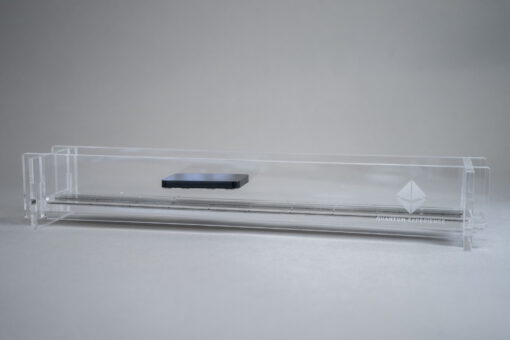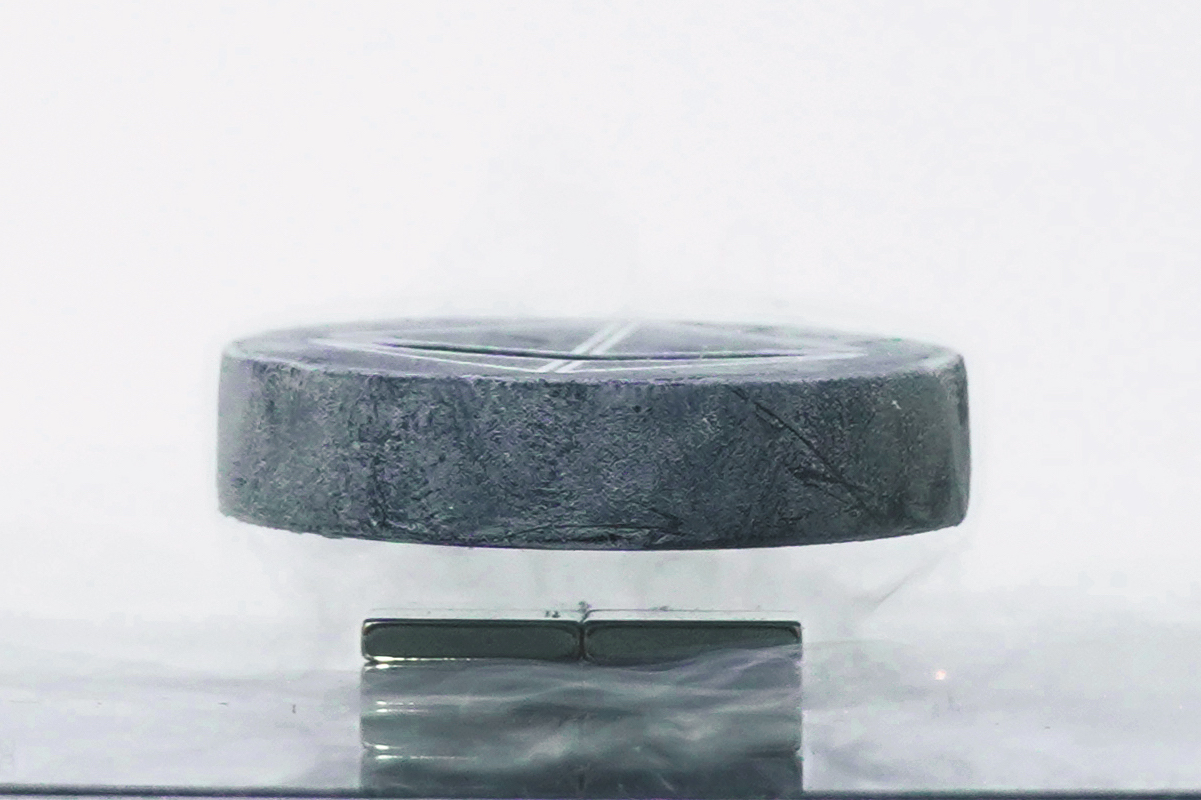
Quantum locking is what happens when a type-II superconductor is cooled inside a magnetic field (or pushed into one while cold): the field threads through it in tiny quantized tubes, those tubes get pinned in place, and the superconductor becomes locked in mid-air — at whatever height, angle and orientation it was frozen in. Tilt it, flip it, hang it under the magnet or send it around a track: it stays exactly where you put it. It is real, it is repeatable, and it is the physics behind every levitator we build.
Quantum locking in one minute
- What it is: a superconductor trapped in three dimensions by a magnetic field — not just pushed up (repulsion) but held in place.
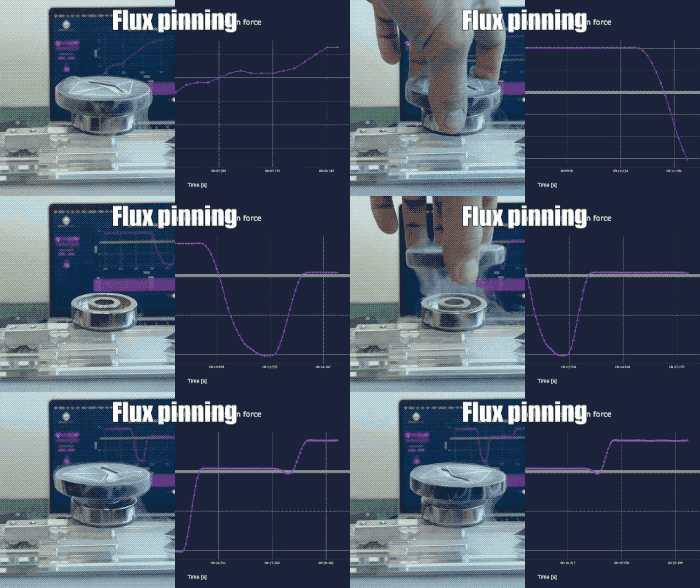
- Why it happens: flux pinning. Magnetic field lines pass through the superconductor as quantized flux tubes; defects in the material pin those tubes, and moving the superconductor would mean dragging the tubes with it, which costs energy. So it doesn’t move.
- What you need: a type-II superconductor (we use YBCO — yttrium barium copper oxide), liquid nitrogen at −196 °C, and neodymium magnets.
- How long it lasts: as long as the superconductor stays below its transition temperature (about −180 °C for YBCO). Once it warms up, the lock releases — softly, not with a jump.
- Is it the same as quantum levitation? Yes. “Quantum levitation” describes what you see; “quantum locking” describes why it holds. Both names refer to the same effect: flux pinning in a superconductor.
How quantum locking works
A superconductor carries current with zero resistance, and below its transition temperature it tries to keep magnetic fields out — this is the Meissner effect. A perfect Meissner superconductor floating over a magnet is like a ball balanced on top of a hill: it repels the field, but nothing holds it in place, so it slides off sideways. Meissner repulsion alone gives you a wobbly, unstable float.
Type-II superconductors such as YBCO do something more useful. Above a certain field strength they stop excluding the field completely and let it through in discrete channels called flux tubes (or vortices). Each tube carries exactly one quantum of magnetic flux — that is the “quantum” in quantum locking. Inside each tube the material is normal, not superconducting, and a tiny whirlpool of supercurrent circulates around it.
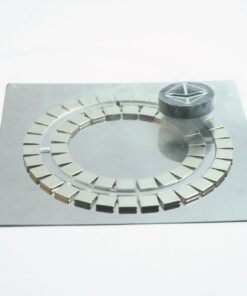 Kit for this projectScience Fair Superconductivity KitFrom $139.00Ships in 1–3 daysView the kit →
Real crystals are full of imperfections: grain boundaries, missing atoms, deliberately grown defects. It costs energy for a flux tube to sit in perfect superconductor, and less energy for it to sit on a defect. So the tubes settle onto the defects and stay there — they are pinned. Now try to move the superconductor. Any displacement would shift the field lines through it, which means dragging every pinned flux tube off its defect. The material resists, in every direction. The superconductor is locked to the magnetic field: it can’t fall, can’t rise, can’t tilt and can’t slide unless you push hard enough to break the pins.
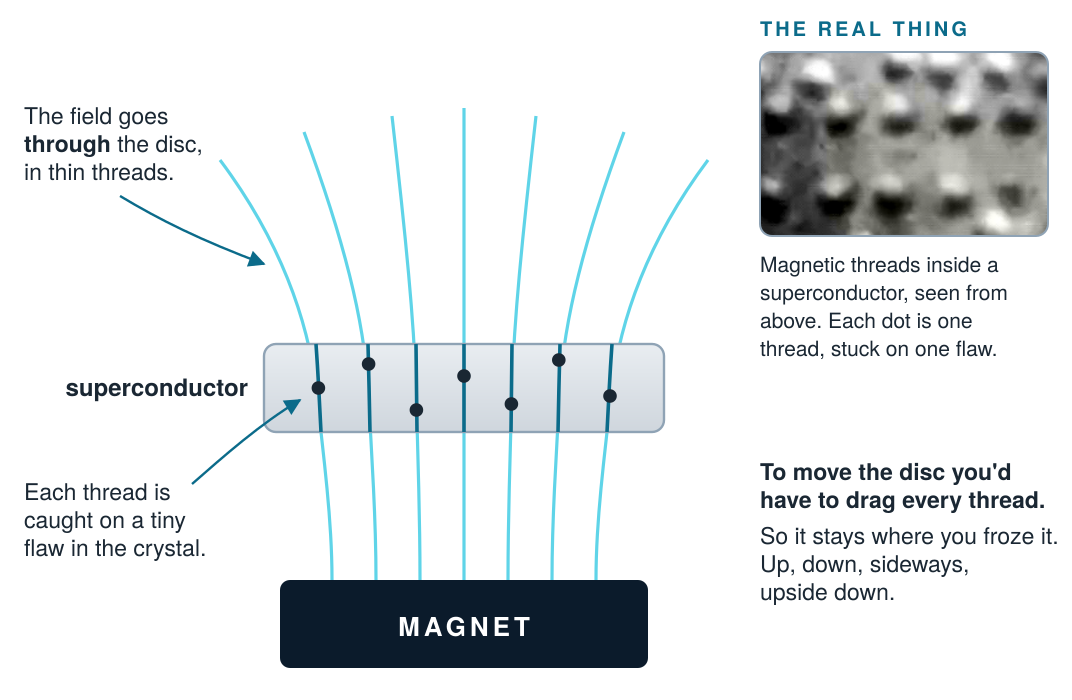
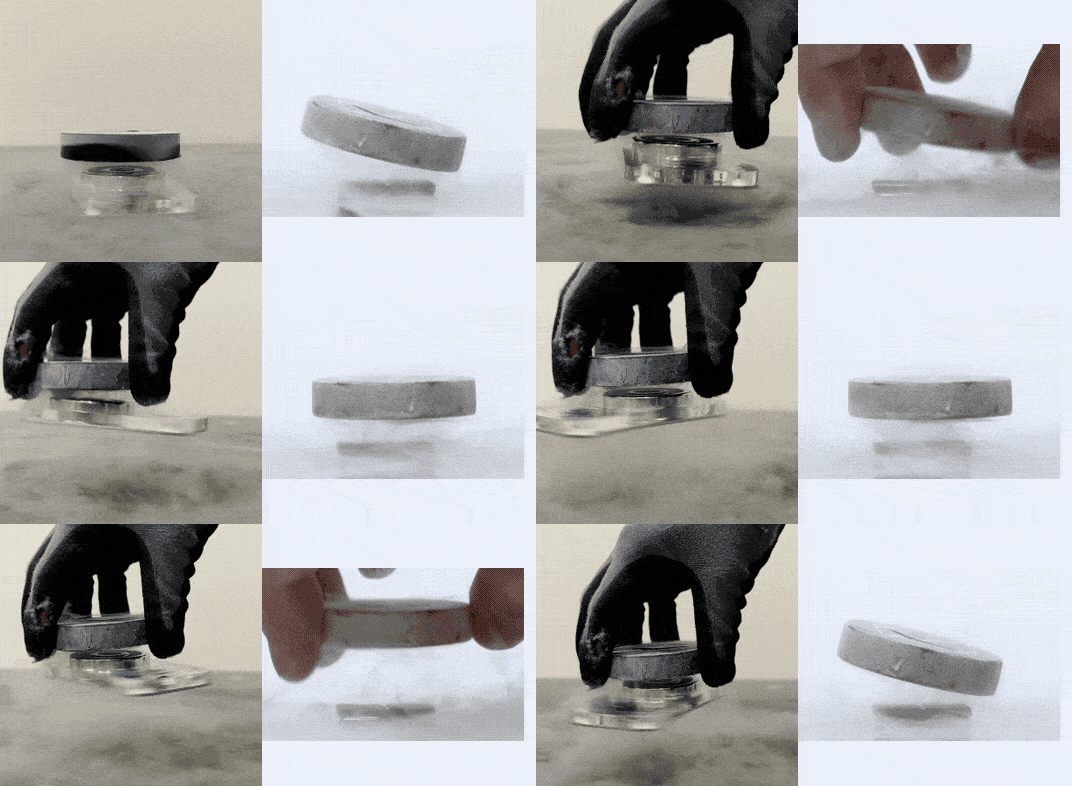
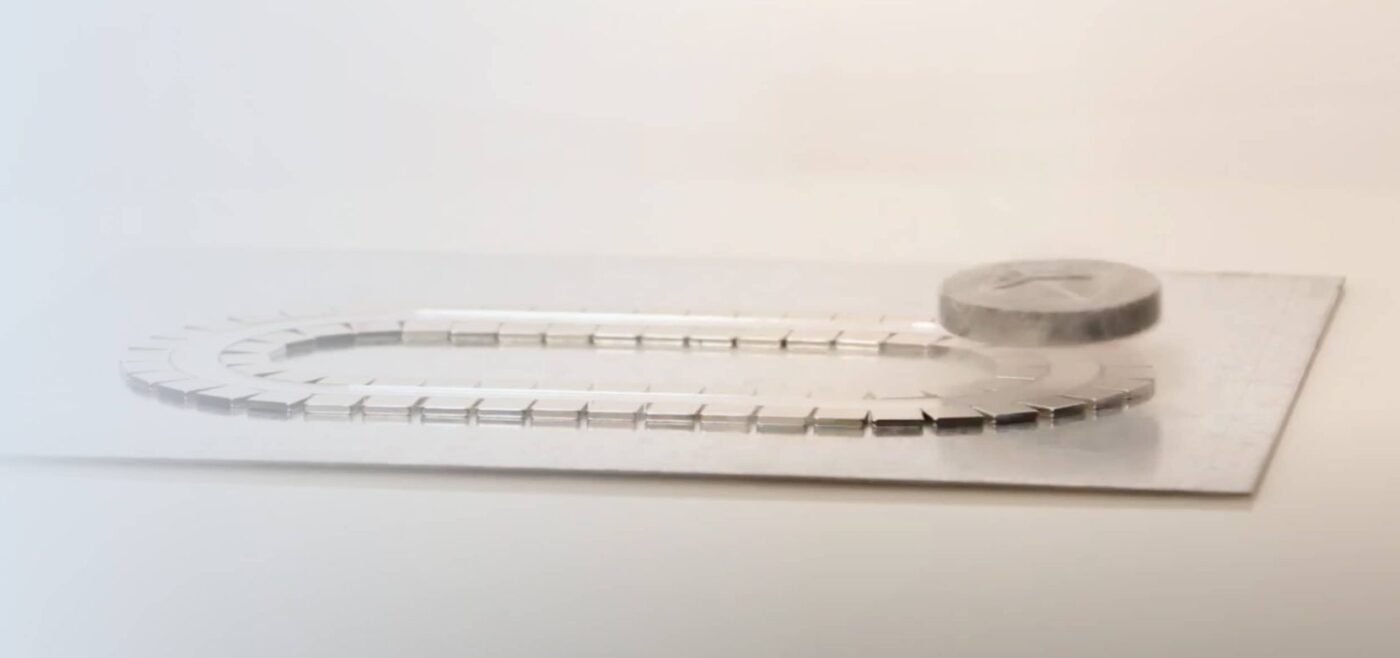
This is why a locked superconductor behaves in ways that look impossible. Cooled at an angle, it stays at that angle. Placed below the magnet, it hangs there. Given a nudge along a circular magnetic track where the field is the same all the way round, it glides with almost no friction because it never needs to break a pin — the field it sees never changes.
The physics, one level deeper
One quantum of flux per tube
The amount of flux in each tube is fixed by quantum mechanics: the flux quantum Φ0 = h/2e ≈ 2.07 × 10⁻¹⁵ Wb (the 2e because the current is carried by Cooper pairs). A field of half a tesla therefore threads a 1 cm² film with roughly 2 × 10¹⁰ tubes. Each tube has a normal, non-superconducting core about the size of the coherence length ξ — only 1–2 nm in YBCO — wrapped in a whirlpool of supercurrent that dies away over the penetration depth λ, about 150 nm. Seen from above, the tubes form a lattice of tiny dots, which is exactly what a magneto-optical image of a superconductor shows (see the inset above).
Pinning force versus driving force
Whenever current flows past a flux tube — and any attempt to move the superconductor relative to the magnet induces such currents — the tube feels a sideways force per unit length of f = J × Φ0, where J is the local current density. Pinning sites push back, up to a maximum called the pinning force density. As long as the driving force stays below it, no tube moves and the lock holds. The largest current the material can carry before the tubes start to slide is the critical current density Jc, so Jc is really a measure of pinning strength. Thin YBCO films reach Jc of order 106 A/cm² at 77 K; a sintered bulk pellet manages a hundred times less. That difference is the whole story of why films lock so much more rigidly than discs, which is the subject of the next section.
How the flux gets in: cool it in the field, or push it in
There are two ways to fill a superconductor with pinned flux. The first is field cooling: cool it through its transition temperature while it is already sitting in the magnet’s field. The flux is inside before superconductivity switches on, it condenses into tubes, and the tubes are pinned from the start. This gives the most complete, uniform lock and is the classic demonstration.
The second is zero-field cooling: cool the superconductor away from the magnet, so it starts in the Meissner state, expelling the field. Now push it into the field. Once the field at its edges exceeds the lower critical field Hc1 — only a few hundredths of a tesla for YBCO — the Meissner state gives way and flux tubes enter from the edges, penetrating inward as far as the pinning allows (the field profile described by the Bean critical-state model, with a slope set by Jc). Once inside, they are pinned exactly as before. If the pinning is very strong, forcing flux in takes a lot of push and the tubes stay crowded near the edges. If it is moderate, as in a demonstration levitator, you can simply press the cold levitator onto the magnet and feel it lock. Both routes work with our levitators, and a good demo often uses both: cool it in place for the first lock, then re-position it cold to show that the lock can be re-made anywhere in the field.
Why the lock is very slightly soft: flux creep
Pinning is not absolute. At 77 K, thermal energy occasionally lets a tube hop from one pinning site to the next — a process called flux creep — so a locked levitator relaxes very slowly and, under a steady load, sags a little over minutes. Cool it further and creep slows dramatically. Creep is also why the lock lets go gently rather than suddenly as the film warms towards its transition temperature: pinning weakens and creep speeds up before superconductivity disappears altogether.
Why thin films lock so much better than bulk discs
Pinning strength depends on how many flux tubes you can trap per unit of material and how firmly each one is held. A thick, bulk YBCO pellet has a large volume for the field to spread through and relatively weak, random pinning; it floats, but with a lazy, springy lock. A thin YBCO film grown on a sapphire wafer is only about half a micron thick, yet it is packed with engineered pinning sites and carries enormous current density. The result is a much stiffer lock: the film holds its position and angle rigidly, supports far more weight for its size, and gives the dramatic “frozen in space” demonstration that made quantum locking famous.
That thin-film approach is what Dr. Boaz Almog demonstrated on the TED stage in 2012 with the Tel Aviv University superconductivity group, and it is the technology inside our Quantum Levitators. If you want the classic bulk-disc experience for comparison, the YBCO bulk levitation disc shows both Meissner repulsion and weaker flux pinning side by side.
Is quantum locking real?
Yes. Quantum locking is an established, textbook property of type-II superconductors, studied since the 1960s and used in engineering today — from superconducting bearings and flywheel energy storage to the proposed maglev systems that ride on pinned flux. The reason it looks like a trick is that most people have only ever seen the Meissner effect, and a superconductor that stays put upside down doesn’t match that intuition. It is not related to quantum entanglement, “quantum energy” products, or anything you can do at room temperature: no superconductor known today locks without serious cooling.
How to demonstrate quantum locking
- Set up the magnet. A single large neodymium magnet, or a track of magnets with alternating poles, gives the strongest gradient. Our demonstration magnets are sized for the levitators.
- Cool the superconductor in the field — or push it in. Hold the levitator a few millimetres above the magnet (or at whatever angle you want to freeze) and pour liquid nitrogen over it; cooling in the field traps the flux tubes and gives the cleanest lock. Alternatively cool it first, then press it down into the field until it locks: as long as the pinning isn’t too strong, the flux tubes are forced in from the edges and pinned just the same. Both work with our levitators.
- Let go. After a few seconds the levitator stays exactly where it was. Tilt it, turn it over, hang it beneath the magnet — it holds.
- Show frictionless motion. On a circular track, a gentle push sends the levitator round and round. The Quantum Levitators have a protective coating over the film, so they can be handled with tongs while cold.
- Warm up and repeat. As the levitator warms past −180 °C the pins release and it settles down. Re-cool and it locks again; the film is reusable for years.
Liquid nitrogen is the only consumable. Our liquid nitrogen guide covers where to buy it, how to store it and the safety rules for classrooms and labs. For a complete, ready-to-teach set with the superconductor, magnets and accessories, start with the Superconductivity Kit; for the full thin-film effect with the longest float times, see the levitator comparison.
Watch quantum locking in action
Two short films from our lab: Quantum levitation and quantum locking shows the levitator locked above and below the magnet and gliding round a track; Is quantum locking real? answers the question most people ask first. For the original demonstration, watch Dr. Boaz Almog’s TED talk, “The levitating superconductor”.
Quantum locking vs. Meissner effect vs. ordinary magnetic levitation
| Quantum locking (flux pinning) | Meissner effect | Magnet-over-magnet | |
|---|---|---|---|
| What holds it | Pinned flux tubes inside a type-II superconductor | Complete expulsion of the field | Like poles repelling |
| Stable without a guide? | Yes, in all directions | No, slides off | No (Earnshaw’s theorem) |
| Can it hang below the magnet? | Yes | No | No |
| Holds an angle? | Yes, whatever angle it was cooled at | No | No |
| Needs cooling | Liquid nitrogen (−196 °C) | Liquid nitrogen | No |
| Best material | Thin-film YBCO on sapphire | Any superconductor | Neodymium magnets |
Frequently asked questions
What is quantum locking in simple terms?
It is a superconductor being held in place by a magnetic field. The field passes through the superconductor in tiny threads that get stuck on defects in the material, so the superconductor can’t move relative to the magnet — it is locked in mid-air.
Is quantum locking the same as quantum levitation?
Yes. They are two names for the same phenomenon, flux pinning. “Levitation” describes the floating you see; “locking” describes the fact that it is held in three dimensions and can even hang below the magnet.
Is quantum locking real or a trick?
Real. Flux pinning in type-II superconductors has been measured and used in engineering for decades. Anyone with a YBCO superconductor, a neodymium magnet and liquid nitrogen can reproduce it in a classroom — or watch our short video on exactly this question.
Can quantum locking work at room temperature?
No. It needs a superconductor, and every confirmed superconductor stops working well below room temperature. YBCO’s transition is about −180 °C, which is why liquid nitrogen (−196 °C) is the standard coolant.
How much weight can a quantum-locked superconductor hold?
It depends on the pinning strength and the magnet. A thin-film Quantum Levitator can support many times its own weight; our levitator comparison lists the measured lift force and float time for each model.
What magnets do you need for quantum locking?
Strong neodymium (NdFeB) magnets. A single magnet demonstrates locking; a circular or straight track of magnets with alternating poles lets the superconductor glide, which makes the maglev-train demonstration.
Do I have to cool the superconductor inside the magnetic field?
No, although it gives the cleanest lock. Cooling in the field (field cooling) traps the flux tubes from the start. If you cool the superconductor away from the magnet it begins in the Meissner state, but pushing it into the field forces flux tubes in through the edges and they pin just the same, provided the pinning isn’t so strong that flux can’t enter. With our levitators both methods work.