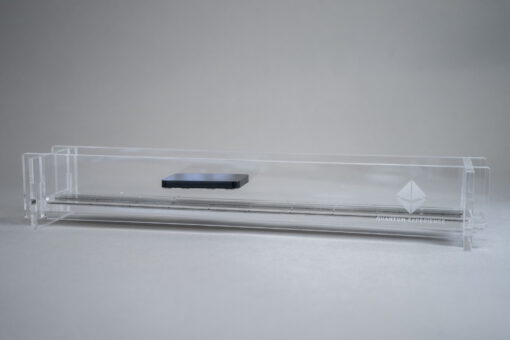
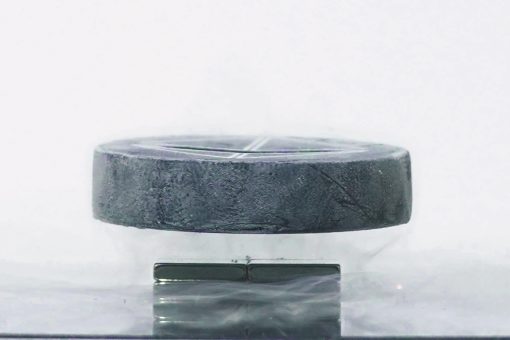
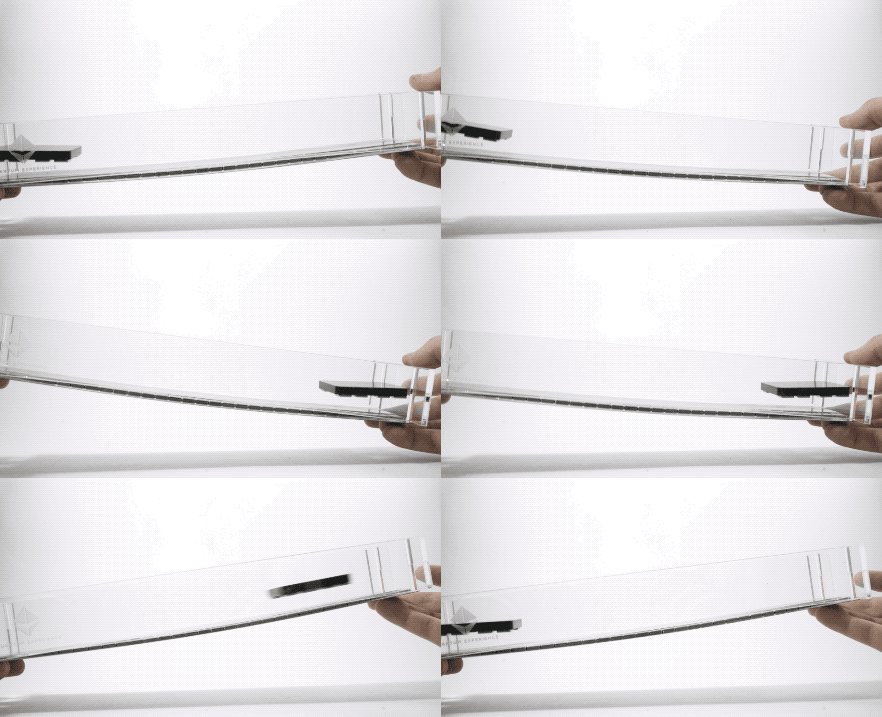
A superconductor floating above a magnet is a demonstration. A science-fair project is an experiment. Judges — and the ISEF judging criteria they work from — reward a testable question, defined variables, controls, repeated measurements and honest uncertainty, not impressive apparatus on its own. This page turns quantum levitation into exactly that kind of project: a quantitative measurement of the flux-pinning force.
The research question
Pick one question you can answer with numbers. Good examples:
- How does the pinning force change with the gap between the superconductor and the magnet at field-cooling?
- Which magnet geometry — ring, cube array, or track segment — pins the disc most strongly per gram of magnet?
- How much payload can a field-cooled disc carry before it detaches, and how does that depend on cooling height?
- How does the force decay as the disc warms after leaving the nitrogen bath?
Variables and controls
Independent variable (change one only): field-cooling gap, magnet configuration, payload, or elapsed time after cooling.
Dependent variable: the vertical force in newtons, or the levitation height in millimetres.
Controls: the same YBCO disc throughout, the same cooling protocol (see below — this matters more than anything else), the same soak time in liquid nitrogen (60 s minimum), and the same magnet unless the magnet is your variable.
 Kit for this projectMeissner Effect & Flux Pinning Force Experiment KitFrom $899.00Ships in 1–3 daysView the kit →
Two ways to measure force
Route 1 — the purpose-built rig. The Meissner Effect & Flux Pinning Force Experiment Kit includes a force-measurement unit, interchangeable magnetic heads and a data logger that exports your readings for analysis. This is the shortest path from question to graph, and the exported data makes the analysis section of your report straightforward.
Route 2 — the kitchen-scale method. With any levitation kit — the Science Fair Superconductivity Kit is enough — place a digital scale under the magnet, zero it, then field-cool the disc above it. Pressing the disc down reads as increased weight; pulling it up (via a light non-magnetic spacer and thread) reads as decreased weight. The scale reading times g is your force. Less precise than the rig, but a well-characterised uncertainty on a cheap instrument is itself good experimental practice — say so in your report.
Method: field cooling is the whole trick
- Fix the gap with a non-magnetic spacer (stacked microscope slides work; measure the stack with callipers).
- Place the warm disc on the spacer above the magnet, then pour liquid nitrogen and let the disc soak for at least 60 seconds after boiling calms. Cooling in the field traps flux lines in the disc — this is what pins it. A disc cooled away from the magnet and brought in afterwards mostly shows Meissner repulsion instead, and behaves differently. Cooling protocol is your most important control.
- Remove the spacer, take your measurement, and record it immediately — the disc starts warming the moment it leaves the bath.
- Repeat each configuration at least five times with a full re-cool between runs. Report the mean and the standard deviation, and put error bars on every point.
What the graph should show
Force against field-cooling gap typically falls off steeply and non-linearly — plot it, then test a functional form rather than only drawing the curve. A table of means and standard deviations, a plot with error bars, and one honest paragraph on the largest source of error (usually warming during measurement, or gap measurement) is worth more to a judge than any amount of extra apparatus.
Explaining the physics without hand-waving
Two different effects are in play and naming them correctly is where most projects stumble. The Meissner effect is the expulsion of magnetic field from the superconductor — pure repulsion, which on its own is unstable. Flux pinning is a type-II superconductor trapping quantised flux lines at defects in the material — which is why a field-cooled disc is locked to the magnet and resists being pushed and pulled. Our primers on Meissner versus flux pinning and how superconducting levitation works cover the depth a judge’s follow-up question will reach.
Safety and permissions
Liquid nitrogen requires adult supervision, eye protection and ventilation — and some fairs ask for paperwork in advance. Our liquid nitrogen guide covers sourcing, handling and a downloadable risk-assessment template you can hand to the fair organisers. If cryogenics are ruled out entirely, the Magnetic Train Science Fair Kit supports a parallel project — measuring levitation height against load with permanent magnets — with no liquid nitrogen at all.
Not sure which apparatus fits your budget and fair rules? Start with the science fair project hub or the which-kit guide.