Quantum Levitation: the teacher’s guide to superconductivity
Demonstrations, student activities and the physics behind them — written for high-school and undergraduate teachers who want to put a real quantum phenomenon on the classroom table.
The PDF is the same guide laid out as an A4 booklet (2 MB) — print it, share it with colleagues, or hand it to students. Revised September 2026 after scientific review.
Superconductivity in high school?
Since its discovery in 1911, superconductivity was only discussed at the high-school physics level as an interesting topic or an anecdote. The phenomenon couldn’t be observed in class because it occurred only at extremely low temperatures — a few degrees above absolute zero (0 K).
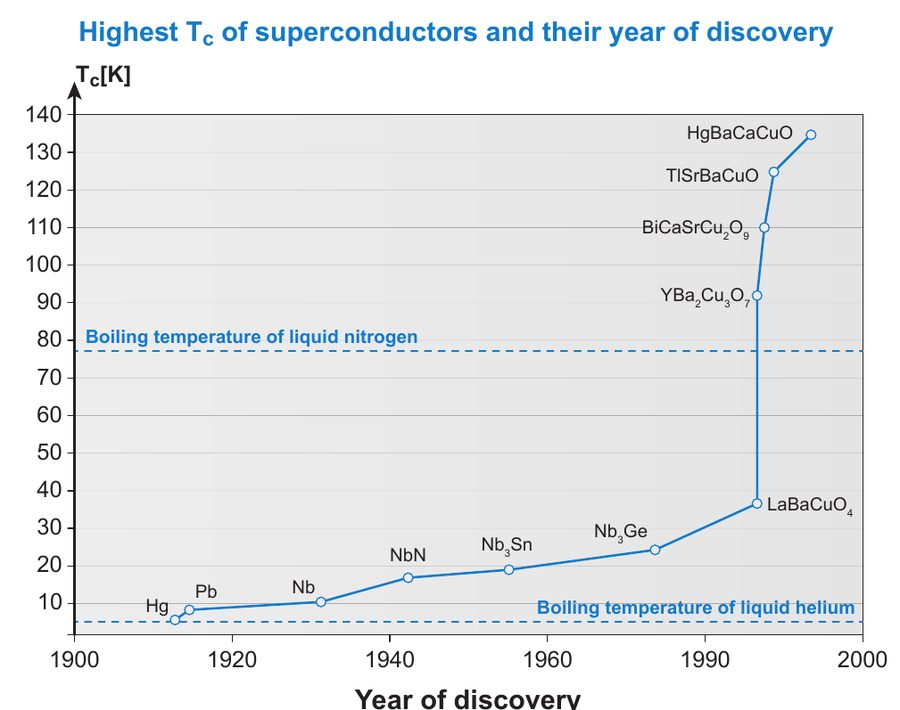
During the late 1980s, the rapid succession of newly discovered high-temperature superconductors, which operate at liquid-nitrogen temperature (77 K), turned the tables. Superconductivity was now well within the reach of high-school students. It became possible to perform classroom demonstrations of magnetic levitation and to observe quantum phenomena using relatively cheap liquid nitrogen.
Quantum Levitation demonstrations always capture students’ attention. They become entranced by an upside-down levitated magnet, they wonder how it works and predict what it can be used for — scientific inquiry has begun. Students’ curiosity will be limited only by their imagination.
Superconductivity is widely regarded as one of the great scientific discoveries of the 20th century and has played a central role in at least five Nobel Prizes in Physics (1913, 1972, 1973, 1987 and 2003). Nevertheless, the history of superconductors is only just beginning. The possible discovery of room-temperature superconductors could bring superconducting devices into our everyday lives; superconductivity is already applied in transportation, power production, medicine and more.
The questions students ask first
Short answers to the questions that come up in every class (and in every search box). Each one is expanded in the chapters below.
How does quantum levitation work?
A superconductor cooled below its critical temperature does two things at once in a magnetic field: it expels most of the field (the Meissner effect, which pushes it away from the magnet) and traps the rest in thin, quantised flux tubes that get pinned to defects in the crystal (flux pinning, which holds it in place). Repulsion gives the lift; pinning gives the lock.
Is quantum levitation real, or a trick?
It is real, repeatable physics that any school can run with a high-temperature superconductor, neodymium magnets and liquid nitrogen. There are no hidden wires, motors or electronics: the levitator is a thin YBCO film on a metal disc. No electrical or mechanical power is needed to keep it floating; the superconductor simply has to stay below its critical temperature, which means removing heat with liquid nitrogen.
What is the difference between the Meissner effect and flux pinning?
The Meissner effect is the complete expulsion of a magnetic field from a superconductor, and it can only repel. Flux pinning happens in type-II superconductors such as YBCO: part of the field passes through as quantised vortices that are trapped by imperfections, so the superconductor resists any movement. Pinning can attract as well as repel, which is why a levitator can hang upside down.
Is quantum locking the same thing as quantum levitation?
Closely related, but not identical. “Quantum levitation” (or superconducting levitation) is the whole phenomenon you see: a superconductor floating above, beside or below a magnet, lifted by the Meissner effect and held by flux pinning. “Quantum locking” is the positional stability produced specifically by flux pinning — the reason the levitator stays put at any angle. The names are often used interchangeably for the demonstration; in this guide we keep them apart.
How cold does the superconductor have to be?
Below its critical temperature. For YBCO that is 92 K (−181 °C), so liquid nitrogen at 77 K (−196 °C) is cold enough, cheap, and far easier to handle than the liquid helium the early superconductors needed.
How long does it levitate?
As long as it stays below 92 K. A thin-film levitator floats for roughly 3 to 15 minutes per dip, depending on its size and the room; it then releases softly as it warms, and a fresh dip restarts it.
How much weight can it carry? Could it lift a person?
The superconducting layer in a levitator is only a few microns thick and weighs about 0.02 g, yet the levitator can carry about 100 g — several thousand times the mass of the film that does the work (Experiment D.1 measures this). Lifting a person needs centimetre-thick bulk YBCO discs, a large magnet array and a continuous nitrogen supply; laboratory bearings and the Lexus hoverboard show the principle scales, but it is not a classroom experiment.
Why does it stay upside down or at an angle?
Because pinning, not repulsion, is doing the holding. The flux tubes trapped in the superconductor would have to move for the levitator to fall or straighten, and moving them costs energy, so the levitator stays exactly where it was frozen — even below the magnet.
What is the difference between type I and type II superconductors?
Type I superconductors (most pure metals) expel the field completely and lose superconductivity abruptly above one critical field. Type II superconductors (YBCO, niobium alloys) let the field in gradually as vortices between two critical fields, which is what makes flux pinning — and stable levitation — possible.
Is liquid nitrogen safe in a classroom?
Yes, with goggles, insulated gloves and a ventilated room. It is non-toxic and non-flammable, but it causes frostbite on contact and displaces oxygen in confined spaces. Chapter C lists the precautions; the liquid nitrogen guide covers sourcing and storage.
Is this how maglev trains work?
Related, but different. Japan’s SCMaglev uses superconducting electromagnets on the train to induce currents in the guideway, which repel and centre it; it does not rely on flux pinning. Track demonstrations with a levitator show nearly frictionless motion using pinning instead, which is why the levitator also stays locked at any angle.
Are there room-temperature superconductors?
Not at everyday pressures. Hydrogen-rich compounds superconduct near room temperature only above about a million atmospheres, and the 2023 “LK-99” claim did not survive replication. YBCO at 92 K, cooled with liquid nitrogen, remains the practical choice for the classroom.
Fascinating properties of superconductors
Zero resistance, the Meissner effect, high-temperature superconductors, real-world applications, and a first look at the quantum mechanics underneath.
A.1 Zero resistance at low temperatures
It had been known for many years that the resistance of metals fell gradually when cooled below room temperature, but it was not known what limiting value the resistance would approach if the temperature were reduced to very close to absolute zero.
The era of low-temperature physics began in 1908 when Dutch physicist Heike Kamerlingh Onnes first liquefied helium, which boils at 4.2 K. Three years later, Onnes passed a current through a very pure mercury wire and measured its resistance as he steadily lowered the temperature. Much to his surprise, there was no levelling off of the resistance until the temperature reached 4.2 K, at which point the resistance suddenly vanished. Current was flowing through the mercury wire and nothing was stopping it; the resistance was zero. Onnes called this new state of zero resistance superconductivity.
In 1913, Onnes was awarded the Nobel Prize in Physics for the study of matter at low temperatures and the liquefaction of helium. Soon afterwards, many other metals were found to exhibit zero resistance when their temperatures were lowered below a certain characteristic temperature, called the critical temperature, or Tc.
The importance of this discovery to the scientific community, as well as its commercial potential, was clear: an electrical conductor with no resistance could carry a direct current with no resistive losses at all.
In a classic experiment by S. C. Collins in the late 1950s, a current was maintained in a superconducting ring for 2.5 years — stopping only because a trucking strike delayed delivery of the liquid helium that was necessary to keep the ring below its critical temperature.
A.2 Expulsion of magnetic fields — the Meissner effect
The magnetic properties of superconductors are as dramatic as their complete lack of resistance. In 1933, Walther Meissner and Robert Ochsenfeld studied the magnetic behaviour of superconductors and found that when certain ones are cooled below their critical temperature, they expel a magnetic field. A superconductor will not allow a magnetic field to penetrate its interior. It achieves this by producing a “magnetic mirror”: surface currents which produce a magnetic field that exactly counters the external field. The expulsion of magnetic fields from the interior of a superconductor is known as the Meissner effect.
A good comparison to electricity is that a good conductor expels static electric fields by moving charges to its surface; the surface charges produce an electric field that exactly cancels the externally applied field inside the conductor. In a similar manner, a superconductor expels magnetic fields by forming surface currents. At ordinary temperatures these currents decay almost instantaneously because of the finite resistivity of the conductor. When the superconductor is cooled below Tc, however, persistent surface currents are induced and produce a magnetic field that exactly cancels the applied field inside the superconductor.
Levitation of a magnet above a cooled superconductor can be explained by the Meissner effect. If a superconductor is cooled below its critical temperature while in a magnetic field, the field surrounds but does not penetrate the superconductor. The magnet induces currents in the superconductor which create a counter-magnetic force that causes the two to repel. The induced currents are due to the presence of the external field itself — not to flux changes, as is the case in ordinary metals (Faraday’s and Lenz’s laws).
The complete expulsion described so far holds only while the external field is weak. What happens as the field grows depends on the type of superconductor. In a type-I superconductor (most pure metals, such as the mercury of Onnes’s experiment) there is a single critical field, Bc: below it the field is fully excluded, above it the field floods in and superconductivity is lost.
YBCO, like all high-temperature superconductors, is type II, and has two critical fields. Below the lower one, Bc1, it behaves as a perfect Meissner diamagnet. Between Bc1 and the much larger upper field, Bc2, the material is in the mixed state: the field enters as thin quantised filaments (vortices) while the rest of the sample stays superconducting. Only above Bc2 does superconductivity disappear. A levitator over a neodymium magnet sits comfortably in the mixed state — for YBCO Bc1 is a few hundredths of a tesla and Bc2 is over 100 T — which is why the vortex physics of section A.5 is essential to every demonstration in this guide.
A.3 High-temperature superconductors
It has long been a dream of scientists working in the field to find a material that becomes a superconductor at room temperature. About half of the metallic elements and a large number of alloys superconduct at very low temperatures, which requires handling liquid helium — a complex and expensive task. A great deal of effort has therefore been directed towards finding new superconductors with higher critical temperatures.
Early in 1986, Georg Bednorz and Karl Alex Müller made a remarkable discovery that revolutionised the field: an oxide of lanthanum, barium and copper became superconducting at about 30 K. Inspired by this, scientists worldwide worked intensively to discover materials with even higher Tc. A year later, a ceramic material, YBa2Cu3O7−δ (YBCO; the δ records a small, adjustable oxygen deficiency on which Tc depends), was found to superconduct at 92 K. This was a milestone because the transition temperature is above the boiling point of liquid nitrogen (77 K) — a coolant that is readily available, far safer, inexpensive and much easier to handle than liquid helium. Bednorz and Müller were awarded the 1987 Nobel Prize in Physics.
The superconductor encapsulated inside the Quantum Levitator is YBCO, a compound of yttrium, barium, copper and oxygen. Its atoms are arranged in an orthorhombic crystal structure (a cuboid unit cell). The material is a poor electrical conductor at room temperature and becomes a superconductor below 92 K. The superconducting layer inside the levitator is only 1–3 microns thick, a crystal grown on a metallic substrate (Hastelloy / stainless steel) and protected by a silver layer.
The mercury-based cuprate HgBa2Ca2Cu3O8+δ exhibits the highest critical temperature known at ambient pressure: around 133 K. Hydrogen-rich compounds have superconducted near room temperature, but only under pressures of more than a million atmospheres, and the widely reported “LK-99” of 2023 did not survive replication. A practical room-temperature superconductor is still an open problem — a good discussion topic for the class.
A.4 Applications of superconductors
Electrical power
The ability of superconductors to conduct electricity with zero resistance can be exploited in transmission lines. Currently a substantial fraction of electricity is lost as heat through the resistance of conventional conductors such as copper or aluminium. If transmission lines could be made superconducting, these resistive losses would be greatly reduced. They would not vanish entirely: real cables still have joints, need refrigeration, and in AC systems suffer small hysteresis losses in the superconductor itself — engineering constraints that today’s demonstration projects are designed to quantify.
High-temperature superconductor (HTS) technologies have developed rapidly in the three decades since 1987; today the HTS industry has advanced to full-scale power equipment prototypes and demonstration projects. The foundation is a new generation of wire, capable of carrying on the order of 100 times more current than a copper wire of the same dimensions, with zero or negligible resistive losses. These wires promise a revolution in the way electricity is generated, delivered and consumed — much as optical fibre did for telecommunications.
Transportation
Magnetically levitated trains employing superconducting electromagnets literally “fly” to their destination, floating above the guideway. Superconducting electromagnets on the train induce currents in levitation and guidance coils set into the guideway sidewalls; those currents create magnetic forces that lift and centre the train, while separately powered propulsion coils push it forward. In 2015 the SCMaglev in Japan reached speeds in excess of 600 km/h.
Superconductivity can improve electrified transport of all kinds, from high-speed trains to advanced ship propulsion: better efficiency and performance, lower weight and fuel consumption, longer range. One can envision a future of vehicles of all sorts gliding above a freeway on superconducting magnets.
MRI
The first large-scale commercial application of superconductivity was magnetic resonance imaging (MRI). The intense magnetic fields these instruments need are a perfect application for superconductors. Normal electromagnets would dissipate a great deal of heat and have huge power requirements; superconducting magnets need almost no power apart from cooling. Once current flows in the superconducting coil, the power supply can be switched off and, because the wire forms a loop, the current persists indefinitely as long as the temperature stays below Tc.
Most conventional high-field clinical scanners (1.5 T and 3 T) are built around a superconducting magnet, because it delivers a strong, extremely uniform and stable field — essential for the resolution, precision and speed of clinical imaging — at a fraction of the running cost of a resistive electromagnet. Lower-field, open and portable MRI systems using permanent or resistive magnets also exist, and are an active area of development.
In 2015, Lexus revived Back to the Future’s famous hoverboard by building it around an insulated core of high-temperature superconducting blocks, housed in a reservoir of liquid nitrogen, riding above a track of permanent magnets.
A.5 The physics behind superconductivity — a quantum phenomenon
Superconductivity is a purely quantum phenomenon. Not surprisingly, a successful theoretical explanation had to wait almost 50 years for the foundations of quantum mechanics to be consolidated. A full understanding requires quantum mechanics beyond the scope of this guide; here the fundamental terms and phenomena are discussed qualitatively.
BCS theory: conventional superconductors
According to classical physics, part of the resistance of a metal is due to collisions between free electrons and the vibrations of the crystal lattice (phonons); part is due to scattering from defects or impurities. Soon after the discovery of superconductivity, scientists recognised that this classical model could never explain the superconducting state: electrons always suffer some collisions, so resistivity can never be zero.
In 1957, three American physicists at the University of Illinois — John Bardeen, Leon Cooper and Robert Schrieffer — developed a model that has since stood as a good mental picture of why superconductors behave as they do. Its central feature is that two electrons in the superconductor can form a bound pair, a Cooper pair, if they experience an attractive interaction. At first sight this seems counter-intuitive, since electrons repel one another. But a net attraction can arise if the electrons interact via the motion of the crystal lattice: the lattice is momentarily deformed by a passing electron, and the second electron is attracted by the displaced positive ions.
The interaction between a Cooper pair is transient. Each electron goes on to form a Cooper pair with other electrons, and the process continues, so that in the end each electron in the solid is attracted to every other electron, forming a large network of interactions.
The pairs are not simply independent bosons parked in one ordinary energy level. What BCS theory describes is a single, macroscopic quantum state shared by all the pairs, with one common phase — the pairs move together, coherently, as one wave. Breaking a pair out of that state costs a finite amount of energy, the superconducting energy gap. At low temperature the lattice vibrations and impurities that scatter ordinary electrons cannot supply that energy, so the collective current flows without any dissipation at all.
The model is expressed in the advanced language of quantum mechanics, but its main idea is that electrons in a superconductor condense into a quantum ground state and travel together, collectively and coherently. In 1972, Bardeen, Cooper and Schrieffer received the Nobel Prize in Physics for their theory, now known as the BCS theory.
BCS theory, with phonons as the glue, explains the conventional superconductors: the pure metals and alloys with Tc below about 30 K. Cuprates such as YBCO also carry their current as Cooper pairs and share the Meissner effect, flux quantisation and the energy gap — but their pairs have a different symmetry (“d-wave”), and what binds them is still not settled almost forty years after their discovery. The microscopic theory of high-temperature superconductivity remains one of the open problems of physics, which is part of what makes the levitator on the classroom table so remarkable.
Flux pinning — the physics of “quantum locking”
Type-II superconductors — and every high-temperature superconductor is type II — admit the magnetic field partially once it exceeds the lower critical field Bc1 (section A.2). The penetration takes the form of thin filaments, called flux lines or vortices. Each vortex is a cylindrical swirl of current surrounding a core that lets some flux through. The vortices repel each other and arrange themselves in an orderly array known as a flux lattice.
Depending on the quality of the superconductor, the vortices may be free to move (clean samples) or strongly pinned to defects (dirty samples). In practice, high-temperature superconductors have defects — missing or misplaced atoms, impurity atoms — in their crystal lattices. These defects and grain boundaries stop the motion of the vortices: flux pinning. Pinning the field lines also means stopping their motion relative to the magnet. Pinning sites can be introduced deliberately by adding impurities or through radiation damage.
Problem solving
Discussion questions, numerical problems and two graph-analysis exercises — with worked answers for the teacher.
B.1 Questions
- Discuss the problems that scientists must overcome before superconductors can be effectively used in our daily lives.
- In your own words, explain the Meissner effect.
- Why was the discovery of YBCO so important? What made it different from the other superconductors known at the time?
- Superconductivity has been central to at least five Nobel Prizes in Physics: 1913, 1972, 1973, 1987 and 2003. Name the laureates and the prize motivation in each case. (Two of the five — 1973 and 2003 — are not covered in this guide and make a good research task.)
- List two applications of superconductors in use today and describe the role of the superconductor in each.
B.2 Problems
- What is the resistance of a superconductor at room temperature if 500 mA of current pass through the sample and 3.5 mV are measured across the voltage probes?
Answer
R = V / I = 0.0035 / 0.5 = 0.007 Ω
- What is the resistivity of the superconductor in problem 6 at room temperature, assuming the sample is rectangular? The sample is 2.5 mm wide and 3.4 mm high, and the distance between the probes is 2.5 cm.
Answer
Use ρ = R·A / L with A = 2.5 mm × 3.4 mm = 8.5×10⁻⁶ m2 and L = 0.025 m: ρ = 0.007 × 8.5×10−6 / 0.025 = 2.38×10⁻⁶ Ω·m (238×10−6 Ω·cm).
- What is the temperature in kelvin, and what state of matter will nitrogen be in, at T = −319 °F (assume atmospheric pressure)? The conversion from Fahrenheit to kelvin is TK = (T°F + 459.6) × 5/9.
Answer
(−319 + 459.6) × 5/9 = 78 K, which is above nitrogen’s boiling point (77 K). The nitrogen is a gas.
B.3 Graph analysis: the resistive transition of YBCO
9) A student ran an experiment to collect data on a YBCO sample. A 100 mA current flowed through the sample while the student measured the voltage across it. The measured voltage and temperature are in the table below.
| R (Ω) | Temp (K) | Voltage (V) | R (Ω) | Temp (K) | Voltage (V) | |
|---|---|---|---|---|---|---|
| 93.8 | 0.000844 | 118.2 | 0.001037 | |||
| 93.5 | 0.000783 | 116.1 | 0.001027 | |||
| 93.2 | 0.000639 | 114.8 | 0.00106 | |||
| 93 | 0.000505 | 112.9 | 0.001049 | |||
| 92.6 | 0.000379 | 110.9 | 0.001035 | |||
| 92.1 | 0.000243 | 109.1 | 0.001022 | |||
| 91.7 | 0.000093 | 106.9 | 0.001009 | |||
| 91.4 | 0.00001 | 105 | 0.000989 | |||
| 91 | 0.000003 | 103.5 | 0.000975 | |||
| 90.8 | 0.000002 | 102.2 | 0.000967 | |||
| 89.9 | 0.000002 | 100 | 0.000951 | |||
| 89.5 | 0.000001 | 97.9 | 0.000944 | |||
| 88.8 | 0.000001 | 95.8 | 0.000918 | |||
| 85.5 | 0.000001 | 95 | 0.000911 | |||
| 85.1 | 0.000001 | 94.3 | 0.000892 |
- Complete the table above using Ohm’s law.
- Using the data, plot resistance as a function of temperature.
- Calculate the slope of the graph where the temperature is above T = −173 °C. (T(K) = T(°C) + 273)
- Estimate the critical temperature from the slope of the graph and the data in the table. Explain how you determined it.
Answers
a) The completed resistance column is R = V / 0.1 A; the filled-in values are shown in the table of the answer key.
b) The graph is shown on the right: a flat, gently sloping normal-state resistance above ~93 K, then a sharp drop to zero.
c) Slope of the normal-state region (100 K and above): a least-squares fit to the eleven points gives α ≈ 5.4×10⁻⁵ Ω/K; taking just the end points (100 K, 118.2 K) gives 4.7×10⁻⁵ Ω/K. Anything in the range 4.5–5.5×10⁻⁵ Ω/K is acceptable — the scatter in the data is a good discussion point.
d) Tc ≈ 91.5 K = −181 °C, read where the resistance departs from the linear trend and collapses to zero.
B.4 Graph analysis: the critical magnetic field
10) For a type-I superconductor the critical magnetic field (Bc) is the external field that destroys superconductivity (the four elements below are all type I; YBCO, being type II, has two critical fields, see A.2). The formula for Bc as a function of temperature T is empirical — based on experimental evidence rather than a solid theoretical foundation:
Bc(T) = B0 [ 1 − (T / Tc)2 ]
Here Tc is the critical temperature in the absence of an external field, and B0 is Bc at 0 K. The table gives four metals, their critical temperature and their critical field at 0 K.
| Element | Tc (K) | B0 (T) |
|---|---|---|
| Al | 1.20 | 0.01 |
| Ga | 1.08 | 0.0058 |
| Hg | 4.15 | 0.041 |
| Nb | 9.26 | 0.1991 |
- Use the formula to plot Bc (y-axis) against T (x-axis) for each element, from 0 K to Tc.
- Is mercury (Hg) a superconductor when an external field of 0.03 T is applied and it is cooled to 3 K? Explain.
- Is aluminium (Al) a superconductor when an external field of 0.002 T is applied and it is cooled to 1 K? Explain.
- Which of the four elements is least sensitive to an external magnetic field? Explain.
Answers
a) The four curves are shown on the right; each falls from B0 at 0 K to zero at Tc.
b) No. At 3 K mercury’s critical field is 0.041 × [1 − (3/4.15)2] ≈ 0.020 T; 0.03 T is above it, so the point lies in the non-superconducting region of the plot.
c) Yes. At 1 K aluminium’s critical field is 0.01 × [1 − (1/1.2)2] ≈ 0.0031 T; 0.002 T is below it.
d) Niobium. The area under its curve is by far the largest — it tolerates the highest field at every temperature.
Demonstrations and student activities
Everything here can be performed with the Classroom Quantum Levitation kit. The activities are written for students working individually or in small groups, and each can just as easily become a teacher demonstration followed by a class discussion.
Each activity lists the equipment needed, describes the demonstration, and gives a physical explanation using the theory students have already met in Chapter A. Together they build theoretical knowledge and let students experience the practical side of superconductors.
The Quantum Levitation experiments use extremely strong neodymium magnets. If not handled carefully, these magnets can cause serious injury. Keep them away from magnetic materials and sensitive electronics.
Liquid nitrogen is extremely cold: −196 °C (−320 °F). It causes severe frostbite on contact, and a splash in the eye can cause permanent damage. It boils off as a large volume of gas (about 700 times the liquid volume) that displaces oxygen, and it makes many materials brittle enough to shatter.
- Protective equipment. Safety goggles for everyone in the room; a face shield for whoever pours or transfers. Loose-fitting cryogenic gloves that can be shaken off instantly — never tight gloves, and never immerse a gloved hand. Long trousers, closed shoes and a lab coat; no open sandals.
- Containers. Only open or vented vessels (a dewar, a shallow foam or metal tray). Never put liquid nitrogen in a sealed container of any kind — the pressure build-up can burst it explosively.
- Ventilation. Use a well-ventilated room; never handle or store it in a small closed space, a lift or a car boot. Keep volumes in the classroom to what the lesson needs.
- Handling. Pour slowly, away from the body. Plastic tweezers for the levitator. Keep students at arm’s length from the tray, and never let anyone touch cooled objects, ingest the liquid or play with it.
- First aid. For skin contact, flush with lukewarm (not hot) water and seek medical attention for anything beyond a brief touch; for eyes, flush for 15 minutes and get medical help.
Check your institution’s cryogen policy before the lesson. Sourcing, storage and a risk-assessment template are in our liquid nitrogen guide.
- Liquid nitrogen
- About 1 litre covers a full lesson of demonstrations; a 2–5 litre dewar keeps it for the day. Sourcing and handling: the liquid nitrogen guide.
- Cooling
- 30–60 s in a shallow tray of nitrogen until the boiling calms down. The levitator is then at 77 K, well below YBCO’s 92 K.
- Float time
- Roughly 3–15 minutes per dip depending on the levitator; it releases gently as it warms, so simply re-dip and continue.
- Magnets
- Keep the neodymium arrays away from phones, cards, pacemakers and each other. Plastic tweezers only.
- Standards
- Supports NGSS HS-PS2-5 (electric currents and magnetic fields), HS-PS3-5 (modelling interactions through magnetic fields) and HS-PS3-2 (energy conservation and transfer), together with the practices of planning investigations and analysing data. Adding a design challenge (for example, a student-built maglev bearing or brake) also reaches HS-PS3-3. Fits A-level and IB physics topics on magnetism, resistance and energy.
C.1 How does quantum levitation work? Two effects at once
The phenomenon of quantum levitation is composed of two different effects that occur simultaneously: the Meissner effect and quantum locking. The rationale of this teaching sequence is to separate the two, so students understand the role each plays. After the levitation is demonstrated, a series of POE (Predict, Observe, Explain) activities follows: first focusing on the Meissner effect, then on the special quantum properties of locking, and finally creating nearly frictionless motion through symmetry in the magnetic field.
Quantum levitation
- Equipment
- Quantum Levitator, plastic tweezers and a strong magnet.
- Method
- Cool the levitator in liquid nitrogen and place it on the table, logo face down.
- Take the small magnet and gently lower it towards the levitator.
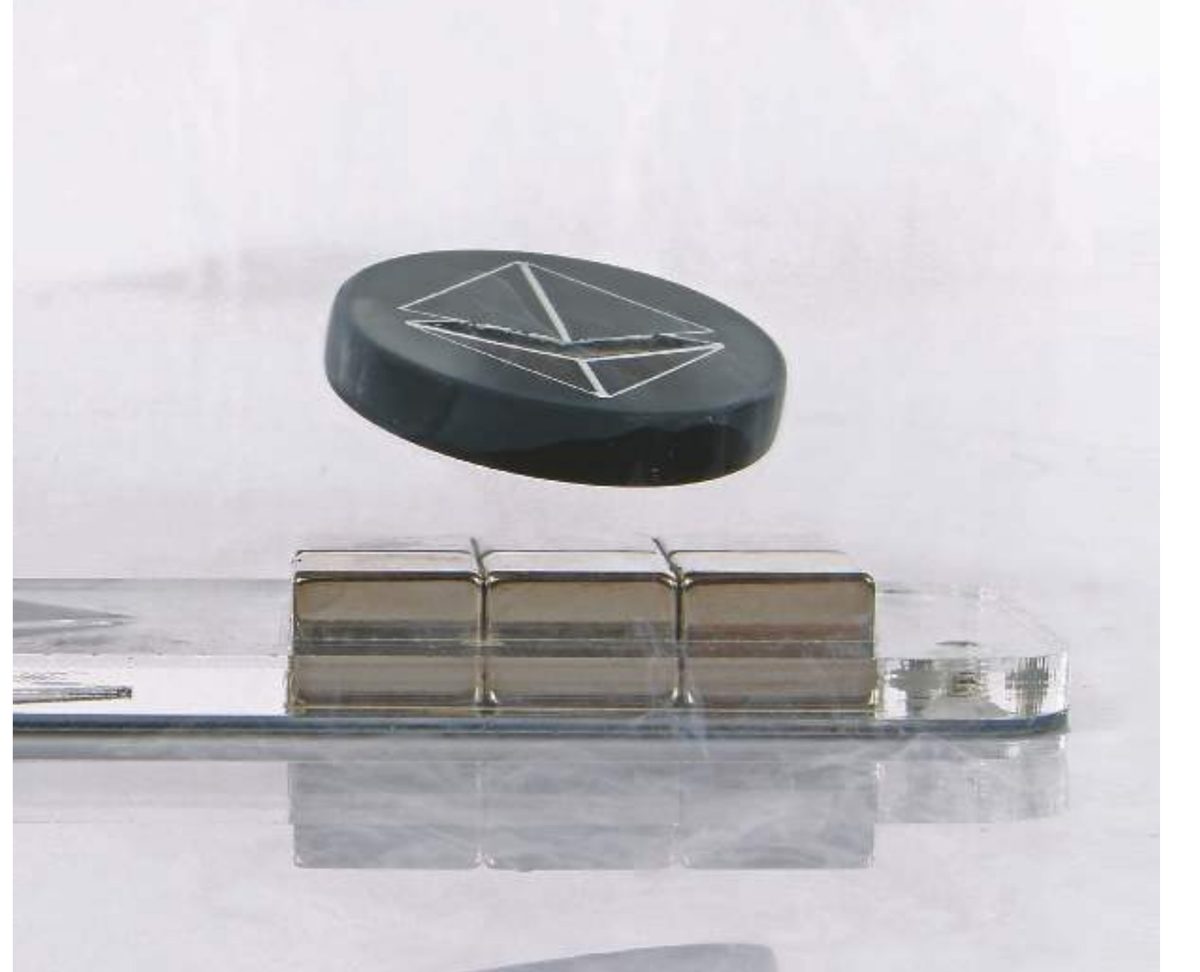
- When the magnet is about 2 cm above the levitator, let go. The magnet will levitate and wobble above the levitator.
- Teacher’s explanation
This simple yet amazing demonstration is explained by the two effects from Chapter A. The Meissner effect makes the magnet levitate: the magnet induces currents in the superconductor which create a magnetic field that repels it. Quantum locking keeps the magnet in place, free only to spin on its own axis. The locking force arises in the superconductor and resists any change; by Newton’s third law the same force acts on the magnet, in the opposite direction. The magnet is therefore locked in position and can only rotate about its symmetry axis — a motion that does not disturb the magnetic flux inside the superconductor.
POE is a teaching strategy that produces immediate observations, surfaces students’ initial ideas and generates discussion by confronting predictions with observations.
- Predict. Ask students to write down what they think will happen and explain it from their previous knowledge.
- Observe. Carry out the demonstration, allowing time to focus on observation, and ask students to write down what they see.
- Explain. Ask students to amend or add to their explanation to account for their observations. Once explanations are on paper, bring the class together to discuss them.
C.2 The Meissner effect
Repulsion regardless of polarity
- Equipment
- Quantum Levitator, plastic tweezers and a strong magnet.
- Set-up
- Students cool the levitator in liquid nitrogen, remove it, and gently bring it towards a small magnet sitting on the table.
- Predict
- What will happen to the small magnet as it gets closer to the cooled levitator? What will happen if we repeat the experiment with the magnet flipped upside down? Use the Meissner effect to explain your prediction.
- Observe
- The small magnet is always repelled from the levitator — even when its polarity is flipped.
- Teacher’s explanation
A beautiful demonstration of the Meissner effect. The superconductor repels the magnet regardless of its polarity (unlike the forces between ordinary magnets). When a magnet is placed near a superconductor, currents form in the superconductor and create a magnetic field similar in size but opposite in direction to the field that formed it. This behaviour is called diamagnetism; a superconductor is a perfect diamagnet. When the field near the superconductor changes — because the magnet is flipped, for instance — the field inside the superconductor changes immediately to produce a mirror field. The superconductor therefore repels every magnet nearby, whatever its polarity.
C.3 Quantum locking
In these activities students meet phenomena that the Meissner effect cannot explain. They can only be explained by flux pinning — quantum locking.
Locked in space
- Equipment
- Quantum Levitator, plastic tweezers and the Handheld magnetic device.
- Set-up
- Students soak the levitator in liquid nitrogen and place it above the magnetic matrix. The levitator levitates.
- Predict
- What would happen if we try to gently move the levitator with the tweezers while it is levitating above the magnet?
- Observe
- The levitator resists any change to its position.
- Teacher’s explanation
In type-II superconductors, such as the YBCO in the levitator, a strong enough external field penetrates the superconductor in discrete quantities called fluxons or magnetic vortices. Inside each vortex superconductivity is locally destroyed, so the superconductor prefers to host them where superconductivity is already weakest. The fluxons are locked in these pinning centres, thereby locking the entire superconductor in space. This is quantum locking, the key to understanding quantum levitation. If the levitator moves, the vortices would have to shift from their pinning sites and the energy rises; the result is a restoring force that opposes any change to the trapped-flux configuration — present even when the levitator is at rest, and pulling it back towards wherever it was frozen.
Hanging upside down
- Equipment
- Quantum Levitator, plastic tweezers and the Handheld magnetic device.
- Set-up
- As before, cool the levitator and place it above the magnetic matrix.
- Predict
- What would happen if the magnets are turned upside down? Will the levitator fall? Use the quantum locking phenomenon to predict.
- Observe
- The levitator hovers underneath the Handheld device and does not fall.
- Teacher’s explanation
Quantum locking forces can be attractive or repulsive: the locking force acts to keep the superconductor in the same place, thanks to the vortices pinned to defects in the superconductor. The levitation here cannot be explained by the Meissner effect, which is strictly repulsive — so a quantum locking phenomenon is observed.
Trapped flux and persistent currents
- Equipment
- Quantum Levitator, plastic tweezers, Handheld magnetic device and a compass.
- Set-up
- Demonstrate the force the magnets in the Handheld device exert on the compass needle by slowly bringing the compass towards them.
- Predict
- What will happen if a cooled superconductor is first locked in a magnetic field and then, with the magnet taken away, placed next to a compass? Consider what happens to the vortices pinned inside it.
- Observe
- The compass needle moves: the superconductor is now acting as a magnet of its own.
- Teacher’s explanation
This is not the Meissner effect — a Meissner current only ever cancels the field that is present, and it dies away with that field. What the compass detects is trapped flux. While the levitator was locked, part of the magnet’s field threaded it as pinned vortices (activity 1). When the magnet is removed the vortices cannot leave: they are held by the pinning centres, and the circulating currents that surround them persist because there is no resistance to damp them. The superconductor keeps a remanent field of its own, like a permanent magnet, until it warms above Tc and the vortices are released. This is the same physics that lets bulk YBCO discs be “charged” as trapped-field magnets far stronger than any permanent magnet.
Quantum locking as a near-frictionless bearing
- Equipment
- Quantum Levitator, plastic tweezers and the Handheld magnetic device. The small magnetic rings in the Handheld device are made of two circular magnets.
- Predict
- What would happen if a cooled levitator is placed on the circular magnet? Consider the magnet’s radial symmetry.
- Observe
- The levitator rotates freely around the symmetry axis of the rings — not around its own centre. Try to lock it sideways and see.
- Teacher’s explanation
There is radial symmetry about the centre of the circular magnet rings, and the same symmetry exists in the field lines. The superconductor can therefore move freely perpendicular to the radial axis (rotate around the centre of the rings), but not parallel to it, because that would change the magnetic flux inside it — the field changes along the radius.
C.4 Final demonstration: the maglev track
This is the most impressive demonstration of quantum levitation.
Nearly frictionless motion along a track
- Equipment
- Quantum Levitator, plastic tweezers and the maglev track.
- Method
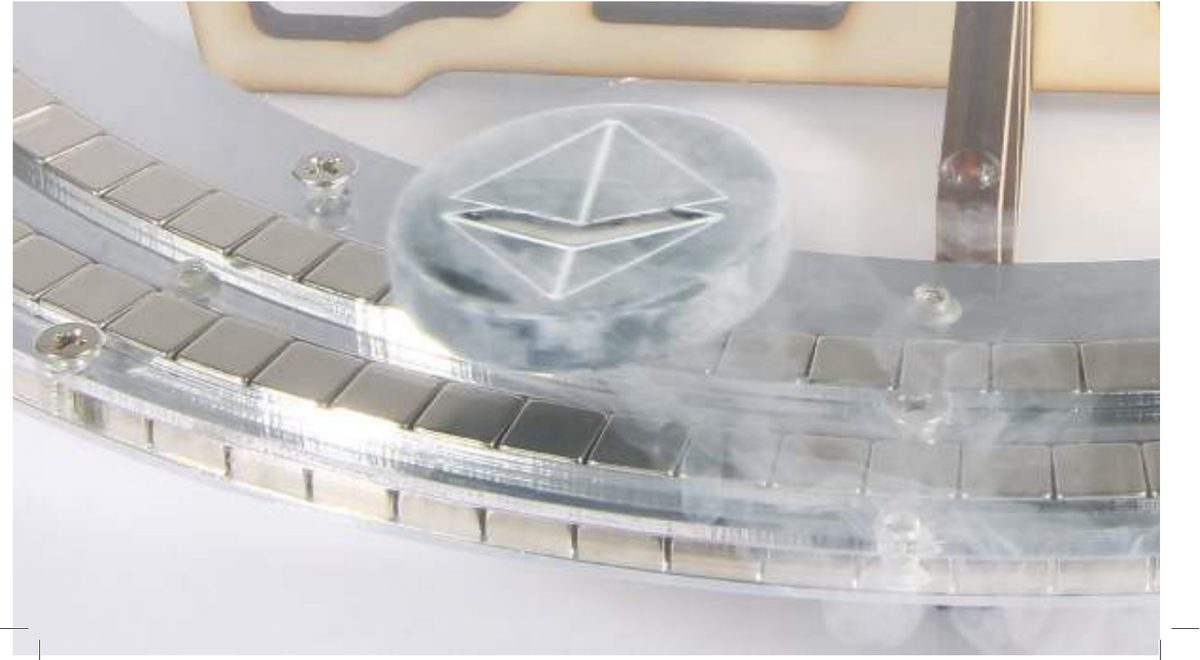
- Have the students cool the levitator in liquid nitrogen and place it on the circular magnetic rail. Push the levitator slightly towards the magnets until it locks, then let it move freely along the track with a gentle push.
- Teacher’s explanation
The track is assembled from magnets with their north/south polarity perpendicular to the plane: all the magnets in the inner ring point north, all the outer ones point south. This forms a symmetry axis similar to the rings in the Handheld device. The magnetic field is identical along the track, which lets the superconductor move freely in that direction while staying locked in every other. There is no mechanical contact, so no contact friction; the levitator does slow gradually, through air drag and small magnetic hysteresis losses where the field is not perfectly uniform — a good question to put to the class.
Quantitative experiments and science-fair projects
Quantum levitation lets students do more than watch. With a force sensor, a multimeter, a stopwatch or a phone camera they can measure real quantum phenomena with their own hands.
D.1 Experiment 1: measuring the levitation force
- Objective
- Measure the magnetic force between the levitator and the magnet array, and observe the hysteresis caused by flux pinning.
- Equipment
- Handheld magnetic device, Quantum Levitator, plastic tweezers, liquid nitrogen and a force-sensor balance stand.
- Method
- Place the Handheld magnetic device on the force sensor and tare the sensor to 0.
- Cool the levitator in liquid nitrogen and hold it with the tweezers while you start recording.
- Bring the levitator towards the magnets until it is a few millimetres away, then continuously pull it back up, increasing the distance from the magnet in a smooth motion.
- Repeat until you obtain a clean, continuous graph.
Data analysis
If the experiment was performed correctly, the graph should look like Figure D1. As the levitator approaches the magnet (Region 1), the repulsion between them increases and so does the net force the magnet applies to the sensor. Both the Meissner effect (always repulsive) and the pinning force (resisting the increase in trapped flux) act to repel here, and the sensor reads their sum: roughly 1 N. Note that the sensor never measures the two separately — it always reads the total magnetic force. What tells the two effects apart is how that force depends on the history of the motion.
By Newton’s third law the levitator experiences the same force upwards, against gravity. The repulsion between magnet and levitator can therefore carry as much as 100 g. This is remarkable given that the levitator weighs about 3 g and, more strikingly, that the superconducting film inside it (a disc 4.5 cm across and about 2 µm thick, density 6.3 g/cm3) has a mass of only about 0.02 g: the film supports several thousand times its own weight.
The most interesting part occurs as the levitator moves away (Region 2). The force decreases with distance as expected, but instead of falling gradually to zero the net force on the magnets becomes negative — something is pulling the magnets upwards. The Meissner effect, which can only repel, cannot explain this. That leaves flux pinning, which opposes any change to the flux trapped inside the superconductor. On the way in, the field was increasing, so pinning added to the repulsion; on the way out the trapped vortices try to hold on to the field they already have, so pinning pulls the levitator back down towards the magnets — and, by Newton’s third law, pulls the magnets up. If that pull exceeds the Meissner repulsion, the total force is attractive and the sensor goes negative. The difference between the approach and withdrawal curves is hysteresis, and it is the signature of pinning: a pure Meissner interaction would trace the same curve in both directions.
You have just measured a quantum phenomenon with macroscopic, quantitative tools.
The superconducting layer inside the levitator is only 1–3 microns (10−6 m) thick — about a fiftieth of a human hair — yet it carries the whole 100 g load measured here. Centimetre-thick bulk YBCO discs used in laboratory bearings and the Lexus hoverboard carry far more, though the force does not simply scale with thickness: how deep the field penetrates, how much current each layer can carry and the shape of the magnetic field all matter.
D.2 Experiment 2: measuring the critical temperature using magnetic levitation
- Objective
- Measure the critical temperature of the superconductor with a resistance thermometer.
- Equipment
- Levitator with a resistance thermometer attached, multimeter, Handheld magnetic device, tweezers and liquid nitrogen.
Phase A — calibrating the resistance thermometer
A platinum resistance thermometer (a Pt100: 100 Ω at 0 °C) is thermally coupled to the superconductor in the levitator. Its resistance falls smoothly as it cools, and platinum is the standard for accurate thermometry from −200 °C to +850 °C — but the relationship is not linear over that range. The international standard (IEC 60751) describes it with the Callendar–Van Dusen equation, which for temperatures below 0 °C reads
R(T) = R0 [ 1 + A·T + B·T2 + C·(T − 100)·T3 ]
with T in °C, R0 = 100 Ω, A = 3.9083×10⁻³, B = −5.775×10⁻⁷ and C = −4.183×10⁻¹². Around Tc this gives 26.7 Ω at 92 K (−181 °C) and 20.2 Ω at 77 K (−196 °C). Use the equation, or the manufacturer’s resistance table for your sensor, to convert every reading.
A tempting shortcut is to calibrate with two easy points — iced water and room temperature — and extrapolate a straight line down to 92 K. It does not work: the curvature of the platinum characteristic means such a line reads about 7 K too low at the transition, which would bury the very effect you are trying to measure. Iced water (0 °C) and, if available, boiling liquid nitrogen (77 K) are still excellent check points for the standard equation: if the sensor reads within a few tenths of an ohm of 100.0 Ω and 20.2 Ω, the wiring and multimeter are fine.
Phase B — measuring Tc
- Connect the resistance thermometer to the multimeter and cool the levitator in liquid nitrogen.
- Place the levitator horizontally above the magnetic matrix of the Handheld device and record the temperature at which it stops levitating and lands completely on the magnet. The disappearance of levitation is an excellent indicator of the transition: above Tc the material is in its normal state, the Meissner response and flux pinning disappear, and the field simply passes through it.
Data analysis
Compare the result with the accepted critical temperature of YBCO (about 92 K). What could explain a difference between the two? (Thermal lag between the thermometer and the film, the finite width of the transition, the oxygen content of the YBCO, and the fact that levitation needs a minimum pinning force — so it fails a little below Tc — are all worth discussing.)
D.3 Experiment 3: superconductivity as a tool for classical mechanics
Quantum levitation and nearly frictionless motion give an accessible, easy-to-use tool for investigating classical phenomena that involve motion. With no mechanical contact, the only losses are air drag and small magnetic hysteresis losses, which yields much cleaner measurements of quantities such as energy and speed — and lets students quantify how far a real system departs from the ideal model.
Harmonic motion
- Objective
- Investigate the harmonic motion of the levitator at different values of the restoring force. Students measure the frequency of the motion as a function of the slope angle of the maglev track.
- Equipment
- The maglev track, a stand to change its slope angle, a stopwatch, liquid nitrogen and a levitator.
- Method
- Cool the levitator in liquid nitrogen.
- Place the cooled levitator on the tilted track, displace it a small angular distance from the lowest point (no more than 10–15° around the track) and release it. Larger amplitudes break the small-angle approximation used below.
- The levitator moves in simple harmonic motion along the circular track. Gravity has two components: one perpendicular to the surface, cancelled by the levitation force, and one parallel to the surface along the track — the restoring force.
- Change the angle of the track by adjusting the height of the stand.
- With the stopwatch, measure the time the levitator takes to complete one oscillation.
- Take several measurements at each height to reduce the error.
Data analysis
The motion can be modelled as a simple pendulum on a string of length L (here, the radius of the track). With the small-angle approximation, the period of a simple gravity pendulum is
T = 2π √(L / g)
In our case the effective gravity is only the component parallel to the track’s plane, g·sin α. For a levitator displaced by an angle θ around the track from its lowest point, the restoring force along the rail is mg·sin α·sin θ ≈ mg·sin α·θ for small θ, which gives the relation between the period T and the slope angle α:
T = 2π √( L / (g · sin α) )
Plot T2 against 1 / sin α to obtain a straight line whose slope is 4π2L/g. Ask students to check whether the period drifts as the oscillation dies away — a measure of the small damping that remains.
Conservation of mechanical energy
- Objective
- Investigate the conservation of mechanical energy in a nearly frictionless system. Students find the relationship between the velocity of the levitator and the height it was released from on the track, and compare it with the ideal prediction.
- Equipment
- The maglev track, a stand to set its slope, levitator, liquid nitrogen, a long ruler, a photogate or a high-speed camera, and Tracker video-analysis software.
- Method
- Cool the levitator in liquid nitrogen.
- Measure the initial height from which the levitator is released, relative to the lowest point of the track.
- Set up the photogate or camera to measure the levitator’s velocity at the bottom of the track.
- With a photogate, place it at the bottom of the track and make sure the levitator passes through it horizontally, sides parallel to the track.
- With a camera, film the levitator at the bottom of the track and analyse the video in Tracker to obtain the velocity.
- Repeat at different heights, taking several velocity measurements at each; measure the height every time it is changed.
Data analysis
Mechanical energy is conserved when the work of all non-conservative forces is zero. There is no contact friction here, and the magnetic force is perpendicular to the motion, so it does no work. In the ideal case the initial potential energy is converted entirely into kinetic energy at the bottom of the track:
½ m v2 = m g h ⇒ v = √(2 g h)
Plot v2 against h. The ideal model predicts a straight line through the origin with slope 2g = 19.6 m/s2. Ask students why the measured slope may come out a little lower (air drag, magnetic hysteresis where the field is not perfectly uniform, the levitator not being released from rest) and how they could estimate the energy lost per run. Turning the approximation into a measured discrepancy is the real experiment.
Ultimate Classroom Kit
Every demonstration and experiment in this guide was written for the Ultimate Classroom Kit: a set of easy-to-run student experiments for a class of 10 to 20, giving students a taste of the work of real quantum physicists.
- 2×Circular maglev tracks
Diameter 40 cm — for the final demonstration and the Chapter D mechanics experiments.
- 8×Handheld magnetic devices
The magnetic matrix and ring magnets used in every POE activity.
- 2×Medium Quantum Levitators
For the teacher demonstrations.
- 8×Quantum Levitators with thermometer
One per student group, ready for the Tc measurement.
- +This guide, instructions and a one-year levitator warranty
Credits. Pedagogical consulting and writing: Asaf Bar Yosef & Arik Gilboa. Graphics and editing: Ziv Ariely. Photographs 5–8 by Maxim Bilovitskiy, Rama, Saruno Hirobano and KasugaHuang via Wikipedia (CC BY 2.0). Scientific review and corrections, September 2026. © Quantum Experience Ltd. — teachers are welcome to print and distribute this guide for classroom use.