Is a superconductor a perfect metal?
Drop a coin over strong magnets and it brakes. Cool the coin in liquid nitrogen and it brakes harder. So what would a superconductor, with zero resistance, do over the same magnets? Students predict, test it, and then cool a superconductor while it sits over a magnet to find out what zero resistance alone cannot explain.
A coin that refuses to fall normally.
A coin falling toward a strong magnet brakes, because the changing field drives currents in it that oppose the change (Lenz’s law). Less resistance means a stronger brake, so students expect a superconductor, with zero resistance, to be the ultimate brake. Part B tests that prediction; the advanced section asks whether zero resistance is the whole story.


From Lenz’s law to the limit of zero resistance.
- Explain how a changing magnetic flux induces currents in a metal and why those currents oppose the change (Faraday’s and Lenz’s laws).
- Predict, using I = V / R, why a cooled coin brakes harder than a warm one.
- Observe that a superconductor cooled away from magnets is repelled when it arrives gently, and locks in place when it is driven deeper into the field.
- Distinguish Meissner repulsion from flux pinning (quantum locking).
- Advanced: explain why cooling the superconductor while it sits over a magnet, not a drop, is the test that separates it from a hypothetical perfect conductor.
Materials, timing, and safety.
Materials
- One Starter Kit. It includes the hardware for Parts A and B: the handheld magnetic device (the magnet array), a cased Quantum Levitator (a yttrium barium copper oxide superconductor, YBCO), and plastic tweezers. You do not need to buy the handheld device separately; it is sold on its own only as a spare part.
- For several groups at once: the Classroom Kit includes 2 handheld magnetic devices and 3 medium Quantum Levitators; the Ultimate Classroom Kit includes 8 handheld magnetic devices and 6 levitators
- One non-magnetic metal coin. Check first that the magnet does not pull on it: some coins contain steel or nickel and will snap to the magnets instead
- Liquid nitrogen in a vacuum-insulated dewar, plus a shallow open tray or foam box
- Cryogenic gloves, safety glasses or goggles (a face shield for pouring); plastic tweezers come with the kits
- A folded towel or foam pad around the device so a levitator that slides off lands softly
- For the advanced runs: a measured non-magnetic spacer (stacked microscope slides, as in the force method) and one small disc magnet
Timing
- Setup: about 10 minutes
- Part A, coin drops with predictions: 10 minutes
- Part B, superconductor drops: 15-20 minutes
- Discussion: 5-10 minutes
- Advanced runs, cooled over a magnet: 15 minutes, optional
- DoHave an adult do every pour
Pour slowly; boiling and splashing are worst when liquid nitrogen meets a warm tray or object.
- DoWear eye protection and loose cryogenic gloves
Gloves protect against brief contact only. Never put a gloved hand into the liquid.
- DoUse plastic tweezers for anything cold
The coin and the levitator stay cold enough to injure skin after they leave the nitrogen.
- DoWork in a well-ventilated room
Evaporating nitrogen displaces oxygen and gives no warning.
- NeverSeal liquid nitrogen in any container
Pressure builds as it boils and the container can burst.
- NeverThrow or drop a bare superconductor
YBCO is a brittle ceramic. Only release the cased levitator, from a short height and as your kit manual allows, over a soft surround.
- NeverLet fingers get between magnets
Neodymium magnets snap together hard enough to pinch. Keep loose magnets away from young children: swallowed magnets cause serious internal injuries.
- NeverBring magnets near pacemakers or cards
Keep strong magnets away from implanted medical devices, bank cards, and electronics.
The coin drop: Lenz’s law as a brake.
Have students predict before every drop. Collect answers on the board without correcting them yet.
Predict
Ask: what happens if a coin is dropped flat onto these magnets from a few centimetres up? Will it fall like it does over the table?
Room-temperature drop
Hold the coin flat and release it about 3-5 cm above the rectangular magnet grid. It slows as it nears the magnets, then lands. Drop it over the bare table for comparison.
Cold drop
An adult cools the coin in the tray of liquid nitrogen until the boiling around it calms. Lift it out with tweezers and drop it the same way within a few seconds, before it warms. It brakes harder than the warm coin.
Why the coin brakes
- As the coin falls, the magnetic flux through it changes. A changing flux induces a voltage around loops in the metal (Faraday’s law), which drives circulating eddy currents.
- By Lenz’s law those currents make a field that opposes the change, so the magnets push back on the moving coin and the fall slows.
- The slower the coin moves, the slower the flux changes, so the currents and the brake shrink. The coin never stops in mid-air. It only slows, then lands.
- Cooling lowers the coin’s resistance. For the same induced voltage, I = V / R gives larger currents and a stronger brake. The same effect makes a magnet fall more slowly through a cooled copper pipe (ETH Zurich lecture demonstration; Harvard’s cooled copper block).
- Take that to the limit, R = 0, and the model predicts currents that never die away. That is the prediction to test in Part B.
The superconductor drop: repelled, or locked.
Every run in this part starts with a levitator cooled with no magnet nearby (the textbook name is zero-field cooling). Starting with no trapped field is what makes the result repeatable.
Cool away from the magnets
Move the handheld device well away from the tray. Soak the levitator in liquid nitrogen for about a minute, until the boiling calms. No magnet nearby means no field is trapped while it cools.
Gentle release: repelled
Hold the levitator flat with tweezers just above the magnet grid, at the short, controlled height your kit manual allows, and let go from rest. It does not settle onto the magnets like the coin. It is pushed away, often tipping and sliding off sideways onto the soft surround. This is diamagnetic screening, usually called Meissner repulsion.
Deeper in: locked
Re-cool away from the magnets. This time guide the levitator down with the tweezers, supporting it the whole way and pressing gently closer until you feel resistance, then let go. Now it stays where you left it, floating, and resists being pushed in any direction. This is flux pinning, also called quantum locking.
A faster arrival can also lock, because momentum carries the levitator deeper into the strong field before the repulsion stops it. Speed is not the only factor: the outcome also depends on how close it gets, the field strength and magnet layout, the quality and thickness of the superconductor, how cold it still is, and any field it holds from earlier runs. Pressing it in by hand, supported throughout, is the controlled way to show the difference. If you show a faster arrival, keep it within your kit manual’s handling limits and treat it as a qualitative observation. Do not throw the levitator or drop it hard.
Reset between runs
To start the next run with no trapped field, lift the levitator off the magnets, let it warm on the tray away from the device until the frost has gone, wipe it dry, then re-cool it away from the magnets. Warming above about 92 K releases the trapped field; re-cooling straight away carries the last run into the next one.
Record
For each run, write down the release height, how it was released (dropped or pressed), and the outcome: landed, repelled sideways, or locked. Repeat each condition at least three times.
Revisit the vote
Did the superconductor act like a super-cooled coin? The coin only braked, then landed; the superconductor was pushed away or locked in place. Save the bigger question, whether zero resistance alone explains this, for the advanced section.
Repulsion, locking, and what a drop cannot prove.
Why the gentle drop is repelled
As the cold levitator enters the magnet’s field, currents flow near the surface of the superconductor without resistance and screen most of the field from its interior. In real YBCO some field can still enter, especially near the edges and where the field is strong. The superconductor acts like a magnetic mirror and is pushed away whichever way the magnet faces (teacher’s guide A.2; HyperPhysics, Georgia State University). Pure repulsion has nothing holding it sideways, so the levitator slides off, like a ball balanced on top of a hill (quantum locking explained).
Why the deeper drop locks
YBCO is a type II superconductor. In a weak field it screens out most of the field, but in a stronger field more of the field gets in through thin tubes called vortices, each carrying one quantum of magnetic flux. Defects in the material pin those tubes in place, so moving the levitator would mean dragging them, and it resists in every direction (HyperPhysics on type II superconductors; teacher’s guide C.3). Pushing closer exposes the disc to a stronger field, which is why the deeper approach locks. CERN’s accelerator school runs the same test with a disc cooled away from the magnet: approach, feel the repulsion, then bring the magnet closer until it levitates and resists sideways motion (Joint Universities Accelerator School 2020 lab guide, activity A.1).

What the drop does not prove
Both outcomes start from a levitator cooled with no field and then moved into one. A hypothetical perfect conductor, with zero resistance and nothing else, would also repel in that situation: by Lenz’s law it would set up currents that never decay and keep the new field out (Feynman Lectures, Vol. III, section 21-6). So the drop shows repulsion and trapping, but it cannot tell a superconductor apart from a perfect conductor. The test that can is cooling it while it sits over a magnet, below.
Cooled away from the magnet, or cooled on it.
For AP physics, IB physics, and undergraduate classes. Here the levitator is cooled while it sits in a magnet’s field (the textbook name is field cooling) and compared with the Part B runs, where it was cooled away from the magnets. The question: is superconductivity just zero resistance plus Lenz’s law?
Cooled over the magnet: locked
Cool the warm levitator while it is held at a fixed gap above a magnet, using a spacer and a setup your kit manual approves for liquid nitrogen, such as the one in the flux-pinning force method. Do not pour nitrogen onto the handheld device unless its manual says you can. Once it is cold, remove the spacer with tweezers. The levitator stays near the height it was cooled at, locked.
Optional: cooled under a magnet
In a cryogenic tray, set a warm levitator superconductor side up and rest a small disc magnet on it, keeping the magnet in place. Cool it and watch the magnet as the levitator becomes superconducting. Some setups show the magnet rising slightly; others show little or nothing visible, depending on the magnet, the superconductor, and the boiling. Treat any lift as a qualitative observation.
Compare protocols
Set the results from steps 10 and 11, cooled in the magnet’s field, beside the Part B drops, cooled away from the magnets. Ask which results a perfect conductor would also give, and which only a superconductor could give.
Two ways to cool, three kinds of material
- Cooled away from any magnet, then moved into a field. An ideal perfect conductor keeps the new field out: Faraday’s and Lenz’s laws drive currents that, with no resistance, never decay. An ideal superconductor keeps it out too. A real YBCO levitator screens most of a weak field, lets a stronger field in as pinned vortices, and can lock.
- Cooled while sitting in the field: the sample is placed in the field first, then cooled with the applied field held steady and the sample kept in place. In an ideal perfect conductor, zero resistance freezes whatever flux it held at the moment it lost resistance, so the field stays inside. An ideal superconductor pushes the field out as it becomes superconducting: the Meissner effect. A real YBCO levitator pushes some of the field out and traps the rest in pinned vortices, which is why it locks near the height it was cooled at.
Meissner and Ochsenfeld found in 1933 that a superconductor cooled in a steady field expels it (Naturwissenschaften 21, 787). The applied field and the sample position were held steady, yet screening currents appeared and the flux inside the sample fell. Faraday’s and Lenz’s laws still hold during that expulsion: the internal flux changes, and the induced voltage matches that change. What they cannot do is choose the final state. A perfect conductor obeys the same laws and keeps its starting flux; a superconductor goes to the state with the field expelled. Faraday and Lenz are valid but not sufficient, which is why the Meissner effect counts as a property of the superconducting state, separate from zero resistance (HyperPhysics; Feynman, section 21-6).
Conclusion
Eddy currents in a metal with finite resistance explain the coin. A hypothetical perfect conductor, with R = 0 and Lenz’s law, would also explain the repulsion of a levitator cooled away from the magnets. Neither explains a superconductor pushing out a pre-existing field while the applied field is held steady. A superconductor is not just a perfect metal.
Take it further
- Measure it: the teacher’s guide experiment D.1 records repulsion on approach and attraction on withdrawal, the signature of pinning.
- Make it a science-fair project: the flux-pinning force method uses the spacer gap during cooling over the magnet as the independent variable.
- Measure the zero resistance itself: measuring superconductivity with a 4-wire setup.
Questions for the class.
- Why does the coin’s brake get weaker as the coin slows down?
- Why did the cooled coin brake harder? What would a coin with no resistance at all do?
- In step 05 the levitator slid off sideways. What would have to be true for it to stay put?
- Why does pressing the levitator closer change the result from repulsion to locking?
- Which of your results would a perfect conductor also produce? Which result could only a superconductor produce?
- Why do you need to warm the levitator before a fresh run that starts with no trapped field?
Where each claim comes from.
On this site
- Teacher’s guide A.2, C.2, C.3, and D.1: Meissner repulsion, quantum locking, and the force measurement.
- Meissner or flux pinning: the gentle drop versus the pushed-in magnet.
- Quantum locking explained: why pure repulsion slides off sideways and pinning holds.
- Flux-pinning force method: cooling over a magnet with a spacer.
- Liquid nitrogen guide: handling, protective equipment, and risk assessment.
External
- R. Feynman, The Feynman Lectures on Physics, Vol. III, ch. 21 (Caltech): Lenz’s law exclusion versus Meissner expulsion when cooled in a field.
- HyperPhysics: The Meissner effect and Superconductivity, type I and II (Georgia State University): perfect conductor versus superconductor, the mixed state, the critical temperature of YBCO.
- W. Meissner and R. Ochsenfeld, Naturwissenschaften 21, 787 (1933): the original field-expulsion result.
- Joint Universities Accelerator School 2020 superconductivity lab guide (CERN Indico): YBCO activities cooled away from and over a magnet.
- UC Santa Cruz demonstration notes and Oberlin College demonstration catalog: cooling over a spacer, trapped flux, and drying YBCO after use.
- ETH Zurich and Harvard lecture demonstrations: stronger eddy-current braking in cooled copper.
- University of Iowa Environmental Health and Safety: liquid nitrogen handling and protective equipment. US Consumer Product Safety Commission: high-powered magnet ingestion risk.
What you need on the bench.
One Starter Kit covers Parts A and B: it already includes the handheld magnetic device, a Quantum Levitator, and plastic tweezers. You supply the liquid nitrogen, a shallow tray, a coin, and protective gear.
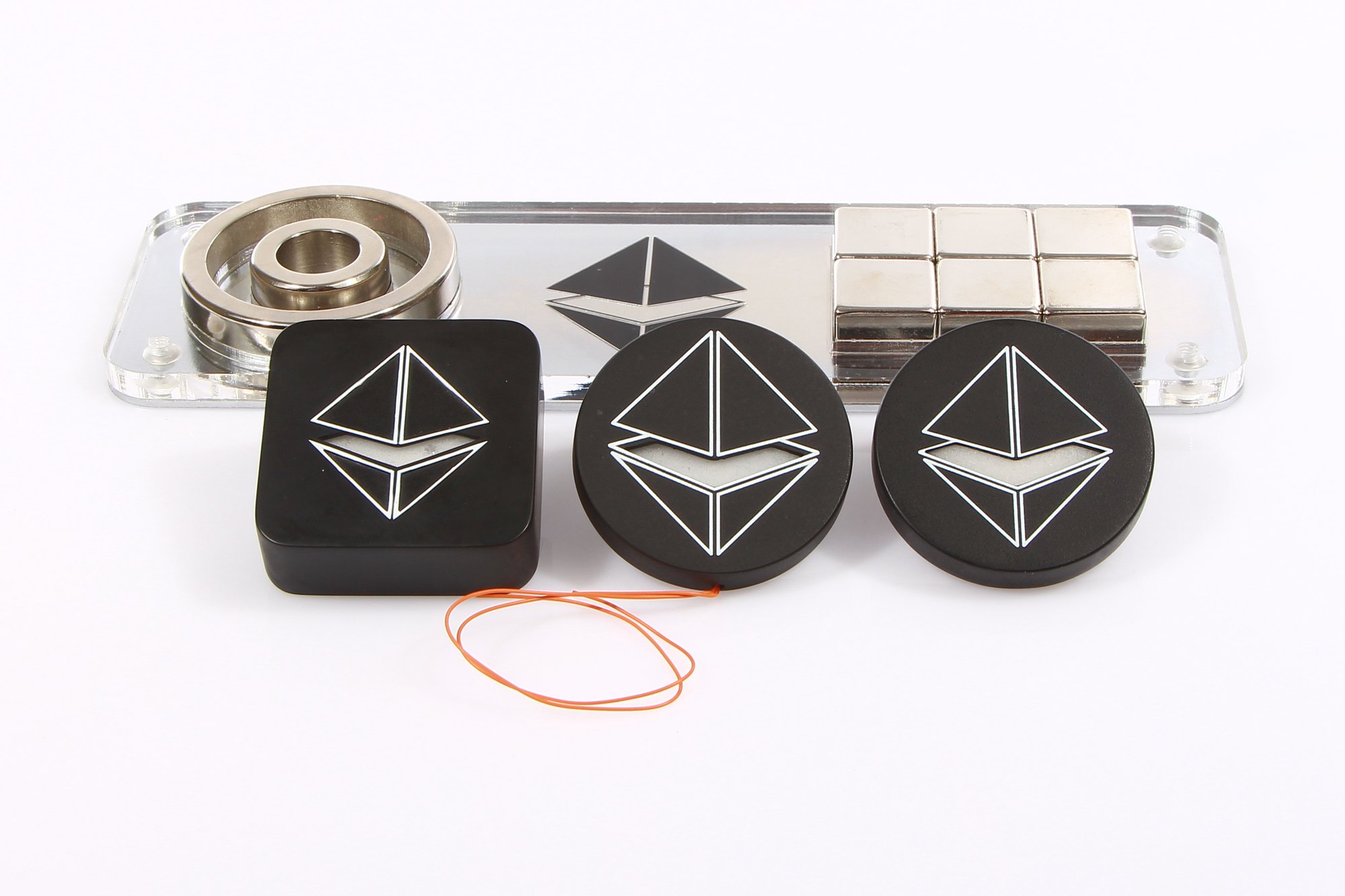
Starter Kit
Handheld magnetic device, a Quantum Levitator, and tweezers for Parts A and B
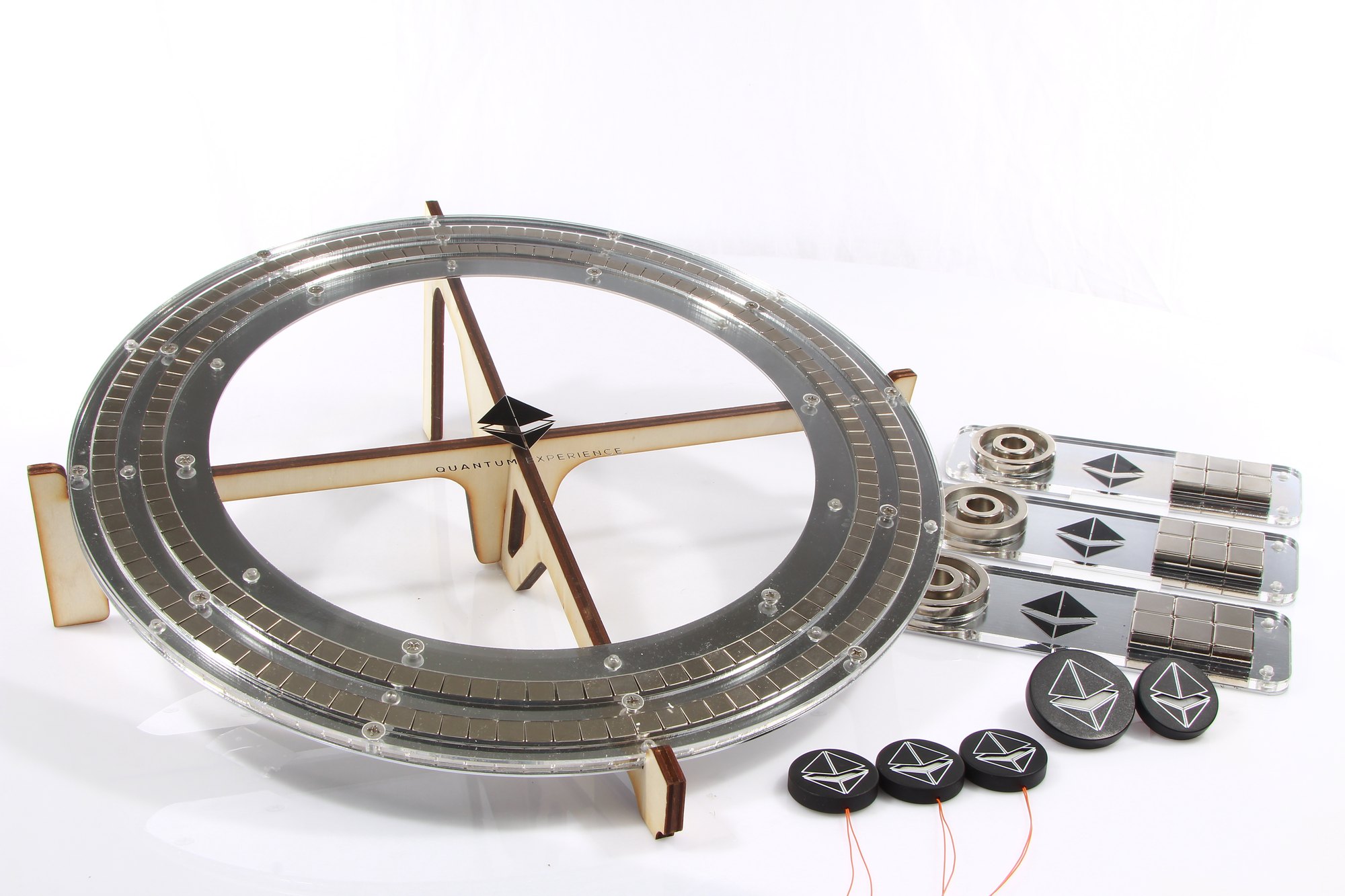
Classroom kits
Several handheld devices and levitators for group stations (see for teachers)
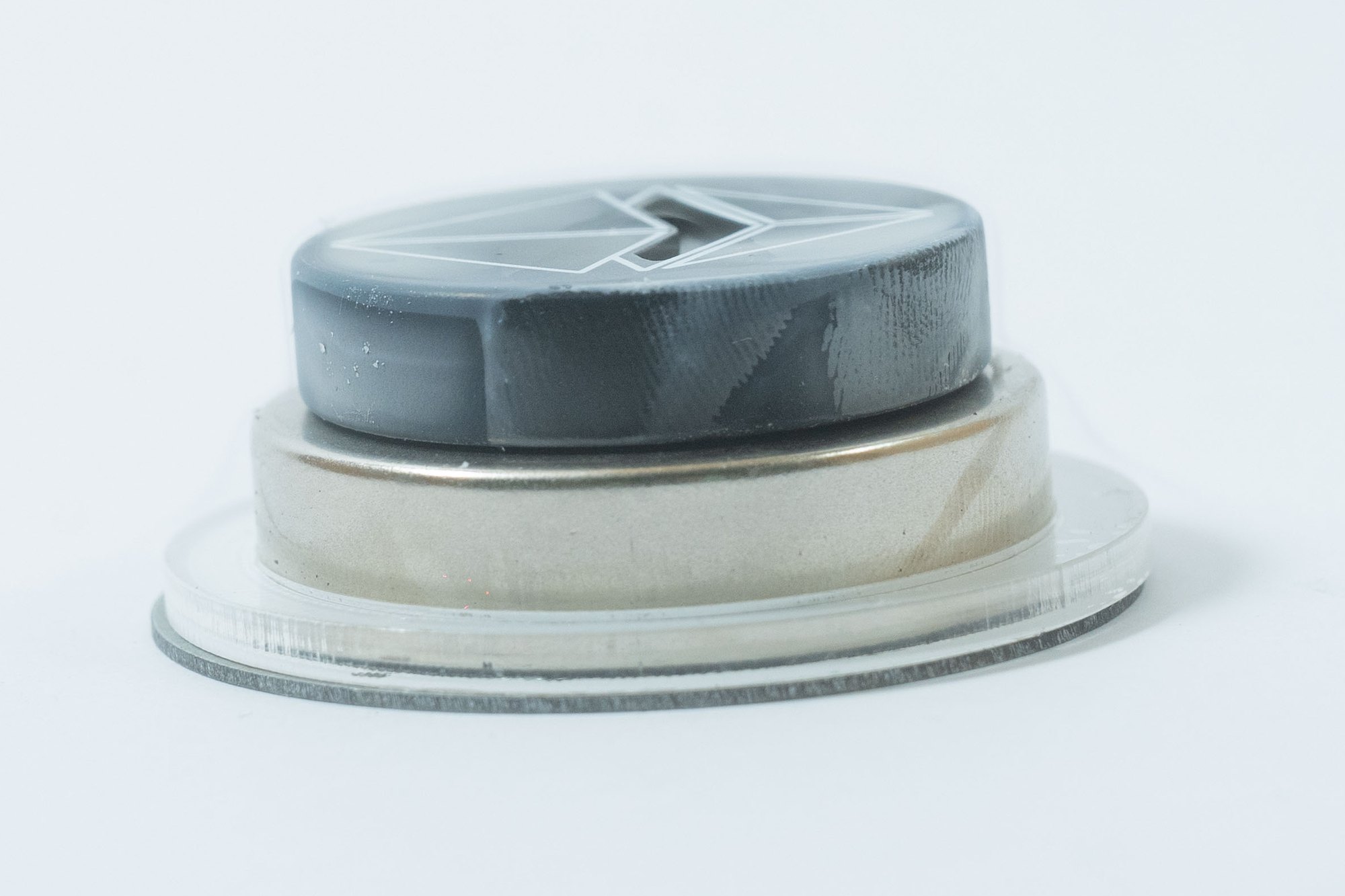
Spare handheld device
Sold as a spare part. Not needed with a Starter Kit, which already includes one
Not sure which kit fits your class size? Use the which kit guide, or request a quote on institutional orders.
Part of a larger set.
This experiment leads into Meissner, flux pinning, force measurement, and maglev projects already on the site. See all class experiments.


Ready for the next period?
Pair this experiment with the free lesson outline, or move on to a measurable science-fair method.